
Leadership Integration Project
Abstract. This thesis explores the intersection of leadership theory and the Fourth Industrial Revolution, arguing that the disruptive rise of Artificial Intelligence (AI) necessitates a fundamental evolution in organizational management. As automation threatens to displace traditional labor and destabilize professional identity, we argue that successful adaptation requires shifting from transactional management to a hybrid framework of Transformational-Servant Leadership (TSL). Theoretically, our work synthesizes the visionary, change-oriented nature of Transformational Leadership with the ethical, people-centric focus of Servant Leadership. It argues that this model is uniquely suited to bridge the gap between technological obsolescence and human potential. By grounding leadership in Maslow’s Hierarchy of Needs, specifically the pursuit of self-actualization, TSL encourages a workforce driven by “calling” rather than mere employment. Our paper also integrates the theory of Learning Organizations, proposing that TSL is the essential catalyst for shifting corporate culture from static knowledge-hoarding to dynamic, continuous learning. It contends that when leaders prioritize the intellectual and emotional self-actualization of their teams, they foster the resilience required to navigate the age of AI. Ultimately, the thesis defines the integration of AI not as a technological challenge, but as a humanistic one: Utilizing leadership to elevate human purpose beyond the capabilities of the machine.
Written by Ruiz Rivera
Capstone Advisor: Prof. George Imbenzi
Trinity Western University, Langley BC Canada
Master of Arts in Leadership (Business)
1 March 2020
Table of Contents
DI - Foreword
Near the start of my graduate journey, I came across a passage that immensely changed my perspective on philosophical questions such as ‘what happiness is’ or ‘how to find meaning in life.’ John Burrough, in his passage titled The secret to happiness is something to do, argues:
The best thing for a man is that which keeps the currents going – the physical, moral, and the intellectual currents. Hence, the secret to happiness is-something to do; some congenial work. Take away the occupation of all men, and what a wretched world it would be! (Watson, 1998, p. 5)
Several studies have proven that when we don’t work, we often spend our idle time on destructive activities such as drugs, alcohol, or criminal behaviour (Krueger, 2017). Rather than use our time for good, we’ll often engage in activities that distract us from our current reality rather than facing it. The secret to happiness, according to Burroughs, lies in discovering our true calling. When we identify the things we are genuinely passionate about, we gain a stronger sense of our identity and purpose with our limited time; and are then moved to act on this purpose (Marciano, 2010).
In my opinion, you know you’ve discovered your passion when you’ve recognized that simply setting and achieving some overarching goal isn’t the end in itself. When you’ve understood that your passion represents a journey where the goals you accomplish are just vindications for the progress you’ve made, and you’re continuously looking towards the next leg of that journey; that’s when your true passion has materialized.
For example, if your passion is to be a champion basketball player, or a millionaire real estate investor, you may come to realize that achieving these far-reaching goals will leave you empty. If you’re like me and that hunger to achieve greatness drives you every single day to the point that it becomes an obsession, then I would challenge you to rethink and look beyond that obsession. I would challenge you to ask yourself the question: why does becoming a champion or a successful investor fuel me? What then happens to my identity once I’m holding up that trophy or when my bank account has reached the million-dollar mark? Will striving for more awards or financial milestones be sustainable? Will my life truly feel fulfilled after it’s all said and done? Probably not.
These far-reaching goals are just that, goals, not passions. They serve as milestones towards a much larger journey that you may or may not realize you’re on. The challenge then becomes articulating what the destination of that journey looks like so that the adventure in of itself is rewarding, sustainable, and hopefully altruistic. For the aspiring basketball champion, their passion may be to spread the joy that the game of basketball brings. For the investor, their passion may be to help others achieve financial freedom. In both these instances, you can see that passion is far more general, but overreaching, and goes beyond the self.
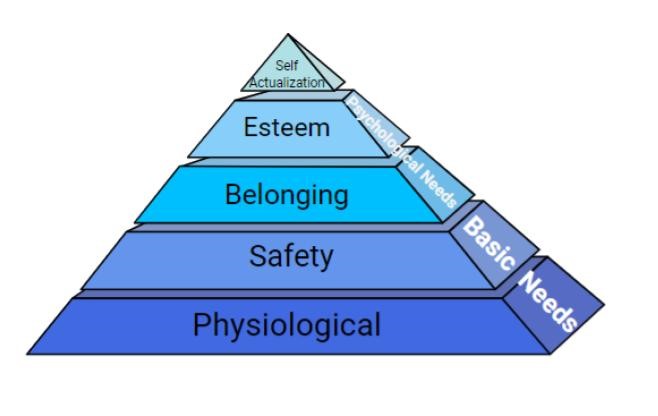
These ideas tie into reaching an internal state of self-actualization; our most sought-after need, according to Maslow’s (1987) well-known theory on people’s Hierarchy of Needs. Self-actualization is a point in our personal development where we have achieved our fullest potential and are no longer working to satisfy our underlying needs, as illustrated in the image below (Maslow, 1987). Although rarely accomplished by most people, the manifestation of self-actualization will look different for everybody. It involves a combination of reaching our physical, intellectual, spiritual, economic, or emotional potential (Maslow, 1987). People who reach self-actualization find true happiness because their everyday actions transcend lesser needs beyond the self (Maslow, 1987). Instead, these people work towards achieving a greater good, a higher purpose, because they can see past the bubble that is their internal reality and instead, focus their efforts on moving society towards their vision of the good.
As I’ve progressed my journey through TWU’s Master’s in Leadership program and its emphasis on the leadership framework, Transformational-Servant Leadership (TSL), I believe I’ve found my true calling. During this program, my professor challenged me to create a mission statement to develop a core understanding of the footprint I want to leave behind. My mission statement is: “To leave the world in a better place than when I came into it by helping others maximize their physical, emotional, and intellectual potential, and then inspiring that mindset of servitude to others.”
When we find that special something which gets us up every day and challenges us to grow, it is truly a blessing. This passion may be something as simple as providing a supportive environment for children, or something more complicated as solving quantum physics; finding these passions and pursuing them is the key to living a genuinely happy life. Consistent with the principles that this framework teaches, I believe my calling is to help others reach that state of self-actualization. My passion is to influence others to find their passion and use their energy, talents, and skills to tackle pressing issues in our society, such as climate change or political conflicts, thus furthering them in their journey towards self-actualization. A strong understanding of our core being, made up of our mission, vision, values, passions, identity, and beliefs, helps create a stronger understanding of our why in life, thus affirming our sense of value and meaning.
With my mission in sight, together with my values of balance, empathy, freedom, passion, perseverance, stewardship, and truth to guide my actions towards my mission, I now have a clearer understanding of my purpose as an aspiring Transformational-Servant Leader. Teaching others to find their passion and serving a higher purpose is a foundational pillar of Transformational-Servant Leadership. It’s why this MA program focuses so heavily on this leadership framework; as a way to produce graduate students who will be definite game-changers in the community. As the final trial before completing this Master’s program, my purpose for this paper will be to discuss the role that Transformational-Servant Leaders will have in adapting its people for the disruptive advancements of artificial intelligence.
Chapter 1: Introduction
Finding one’s purpose and then pursuing it is a journey within a journey. Unfortunately, however, finding that purpose may become even more challenging due to the era we live in. Since the start of the Industrial Revolution, people have mainly tied their identity and passion with their occupation as a response to the increasing efficiency of technological advancements (Yang, 2018). While technology increased productivity, it also increased the demand for labour as companies moved to capitalize on the capabilities that both people and technology can provide together (Lamb, 2016). We’re now on the precipice of another Industrial Revolution spurred by the growing advancements of artificial intelligence (Schwab, 2016). But this time, things will be much more different. While this modern Industrial Revolution will increase economic productivity, it will also displace workers in numbers we have never seen (McKinsey Global Institute, 2017). For many, these technological advancements will challenge our previous understanding of work and the relationship it has to our identity.
Advancements in the field of machine learning, and to a broader extent, artificial intelligence, will be predominantly responsible for these massive industry disruptions. For those unfamiliar, machine learning is the application of artificial intelligence on computer systems through a process similar to how the human brain learns (Alpaydin, 2016). Rather than coding individual instructions (input) to produce a specified action (output) like traditional software, machine learning harnesses data to generate the most optimized output on its own (Alpaydin, 2016). Machine learning is everywhere. The video recommender systems utilized by YouTube and Netflix, the news feed on Facebook or Twitter, or the traffic conditions feature on Google Maps constructed by cell phone location data are just some of the everyday examples of machine learning. Whenever you encounter smart technology, there’s a good chance that machine learning algorithms are behind them.
Ten years ago, this task would’ve been impossible for any computer to generate due to the lack of data. However, the explosion of social media and smartphones have now allowed us to produce a plethora of data for machines to utilize. Everything from the pages we visit, the content we consume, the words we search, the pictures we upload, to even the time we spend browsing a page, all generate data for machines to learn from.
The process is similar to learning a skill such as shooting and dribbling a basketball. Think of data as every minute spent practicing and studying the game of basketball. With enough practice time and study, a player will eventually learn the nuances of the game and develop strategies to optimize his or her preformance. Imagine if this player could practice endlessly without tiring, eclipsing Michael Jordan’s skill would then take just a matter of weeks. In the process, this player may even come up with new, creative, or unconventional techniques that add another dimension of craftsmanship to the game of basketball.
As more and more people are exposed to technology, estimates have found that by 2020, the entire planet will collectively produce over 1.7 MB of data per second; all of which can feed into machine learning algorithms (Ahmad, 2018).
Advances in machine learning have begun powering technology such as autonomous, self-driving vehicles, MRI analysis for early signs of cancer, and tax preparation software; all tasks which humans do for a living salary. Machine learning programs have even defeated top-ranked players in games that require tremendous amounts of skill and creativity, such as Go and Starcraft (Silver, Hubert, Schrittwieser, & Hassabis, 2018). These achievements have shown that artificial intelligence is fully capable of surpassing higher-order human cognitive abilities. While this will certainly spell doom for many industries and occupations, in another sense, it also liberates us from mundane tasks, giving us the freedom to do more creative or meaningful work.
In this book, I’ll introduce the challenges that come with integrating AI in society as well as the opportunities it creates. My intention is to take a holistic approach to how organizations, and to a more considerable extent, society, can evolve alongside the opportunities that AI presents, rather than getting left behind.
I’ll begin my focus on the approach that people can adopt individually to help others adapt to the coming changes by demonstrating leadership, educating, and encouraging others to participate in this revolution. In the upcoming sections, I’ll explore the very roots of what leadership entails, and other proposed frameworks, before examining my recommended approach, Transformational-Servant Leadership. Next, I’ll take a broader view by examining the effect that advancements in AI are currently having on the Canadian labour market and how Canadians are driving opportunities from these progressions. Putting together all the information I’ve gathered, my last section will focus on how leaders can shape their people to evolve alongside and create social value for the broader community; supported by a case study of a leader who’s been successful in this endeavour.
As a framework, Transformational-Servant Leadership addresses the genuine growth of its people, both personally and professionally, for the betterment of the groups they lead. Due to its approach, the Transformational-Servant Leadership framework has the potential to help people evolve alongside the increased integration of artificial intelligence in society. For Transformational-Servant Leaders, the challenge will be how to facilitate this evolution successfully. The challenge will be how to rethink what work is, and what it means to us when AI advances enough to replace a significant fraction of jobs. Whether we like it or not, this new age is coming, and leaders today must be willing to help their people transition for the changes tomorrow.
Chapter 2: The need for leadership
With every notable advancement in human history, both good and bad outcomes have resulted from our prowess. We have to remember that technology is but a tool from which we can do good or evil. Its only purpose is to augment human ability, not dictate its use. Humans ultimately decide what to do with that technology, whether to uplift and advance humanity’s overall standard of living or further oppress and plunder the weak. As a society, we need to decide how this technology will shape our future. Will we use artificial intelligence to widen the socioeconomic gap between society’s elite and its oppressed? Alternatively, can we share the bounty fairly and increase everyone’s quality of life? The answer to this will hinge on the type of leadership today’s leaders have on their people. From government, corporations, nonprofits, educational institutions, small businesses, or local community groups - everyone will have a stake in our future. At the heart of it all, leadership will influence how people respond to the challenges and we’ll allocate resources equitably.
With the apparent need for strong leadership during this period of crucial transition, we have to ask the question: what is leadership and why is TSL more suited for this transition over other frameworks? These are all legitimate questions to explore in this crucial period of human evolution. To tackle this complex query, I’ll first explore the question of what leadership entails.
The notion that leadership is a process implies the period of exchanges or the time spent between a leader and a follower (Northouse, 2016). This position counteracts common misconceptions that leadership is an ability or trait that’s inherent among extraordinary types of people. There’s still ambiguity in the scholarly community as to whether leadership is characterized by the characteristics and behaviours that a leader exhibits, or if it encompasses the essence of the interaction between leaders and followers (Northouse, 2016). Since Transformational-Servant Leadership is a leader-centric approach, I’ll take the approach that leadership is a skill that leaders can hone to improve their relationship with followers (Northouse, 2016).
What’s also self-evident with leadership is that it must occur in groups, with a distinct leader and one or more followers. A key component of leadership is that the leader-follower relationship is not a one-way, but a two-way interaction where a leader is just as affected by his or her followers (Northouse, 2016). The behaviour of a leader’s followers should affect the leader’s conduct with them; otherwise, that leader-follower dynamic is disrupted (Northouse, 2016).
The last two components are related. The leader’s interaction, or influence, towards a group, is to achieve the group’s common goal (Northouse, 2018). Since a leader is ultimately responsible for ensuring the completion of that common goal, they must be able to utilize the group’s skills and resources to succeed. Successfully coordinating the group’s efforts requires the ability to influence others to achieve a collectively desired outcome.
Chapter 3: Exploring alternative approaches to leadership
While the concept of leadership seems reasonably straightforward, there ‘s been many frameworks of leadership that’s developed over time. Research has shown that many of these approaches are effective within a given context (Asrar-ul-Haq, M. & Anwar, S., 2018). Many have even served as the theoretical backbone for the corporate culture of leadership teams in successful organizations. Evaluating some of these approaches will provide us with a better understanding of the role that Transformational-Servant Leaders need to fill regarding the seismic changes that AI will have on society.
What’s perhaps the most contrasting approach to Transformational-Servant Leadership is Transactional Leadership. Transactional Leadership theory posits that leaders can create effective relationships with followers by addressing their basic needs (Northouse, 2016). These leaders use their access to resources as the basis of their relationships with followers by rewarding or punishing certain behaviours. In the context of a work environment, this usually involves a manager’s ability to hire, fire, promote, suspend, compliment, or criticize employees; incentivizing them to maintain a good relationship with their manager (Johnson, 2018). In the long run, using this lone approach to leadership is unsustainable because followers will require higher levels of engagement. One reason for its unsustainability is because employees who develop their skillset over time attract more opportunities from competing companies; thus becoming less dependent on a managers’ contingent rewards. Other employees may also tune out emotionally to their managers’ demands and search laterally for growth opportunities elsewhere. Whatever the case may be, using Transactional Leadership alone will always lead to losses in productivity and revenue from the higher rates of employee turnover correlated to this approach (Dai et al., 2013). However, using elements of Transactional Leadership as a tool for engaging with others is sometimes necessary; such as with political affairs in upper management (Johnson, 2018).
Another prominent approach to leadership is the Authentic Leadership Theory. Authentic Leadership Theory posits that leaders who are self-aware of their values, motives, and self-awareness tend to exhibit traits that relate favourably with followers; such as transparency, high moral character, confidence, and objectivity (Avolio et al., 2004). Transparency from organizations that drive the AI revolution will be essential since they play such a decisive role in how society adapts to their growth and how to govern their use of AI and big data. This transparency is a fundamental component of authentic leadership. Some of these processes will include their collection and usage of data, the applications of data and machine learning algorithms, and the organizations they’ll partner with.
While many would agree with the importance of authentic leadership in this AI revolution, therein lies a fundamental flaw in this framework. The flaw with the Authentic Leadership framework of being true to the values that a leader upholds doesn’t necessarily equate to morality in their values (Johnson, 2018). For example, let’s examine one of the components of Huawei’s mission statement, a company that’s unquestionably one of the critical drivers of AI advancement. In Huawei’s website, the second pledge of their vision is to “provide pervasive intelligence to drive businesses forward” (Huawei Technologies Co., n.d.). An authentic leader or follower within Huawei who’s aligned their mission with the company’s mission will internalize progressing the organization’s vision as their own. By doing so, this leader would strengthen their feeling of authenticity towards themselves, their followers, and to the organization. However, as I mentioned earlier, the mission that this leader aligns themselves with may not necessarily be virtuous.
We’ve already mentioned the potential of AI to displace millions of workers, which alone would create a profound rift in labour markets, local economies, and people’s mental well-being; more on this later. Yet we haven’t even scratched the surface of the consequences that ‘pervasive intelligence’ may have in the hands of misguided business leaders or hackers. Is ‘pervasive intelligence’ in our society even a good thing? To understand the implications of this wording, let’s first understand the context with which we use the term ‘pervasive intelligence.’
Further on in their mission statement, Huawei explains that they aim to ‘turn pervasive intelligence into reality’ by increasing interconnectivity amongst devices and embedding them all with AI technology (Huawei Technologies Co., n.d.). Interconnectivity amongst all devices facilitates a more personal experience between a user and their device. This interconnectivity is made possible by enabling a device to save data generated from its user into a data center, a physical storage space that houses servers and is managed by the company (Mohn, 2018). This process is called cloud storage. Within these massive pools of data, a machine learning algorithm then uses that data to make predictions or create personalized experiences through the analysis of the user’s behavioural pattern (Mohn, 2018). Every day, companies are learning more and more about the people who use their services, such as where they live, where they shop, whom they associate with, fingerprint patterns, their interests - literally everything. Advancing a world where intelligence is pervasive could signal the end of privacy as we know it. The more people use AI-embedded technology, the more information companies have on their users, thus granting near unlimited power to these companies or the hackers who breach their cybersecurity protocols. The threats to users privacy isn’t something that consumers aren’t typically well-educated on or give consent to whenever they purchase a Huawei product. If that weren’t enough, when companies such as Huawei allegedly pair with the powerhouse that’s the Chinese government, with their political agenda of creating a surveillance state, it puts the rest of the global community at unease (Cilluffo, & Cardash, 2019).
Leaders and followers who utilize an Authentic Leadership framework in their practice without fully understanding the scope of their organization’s underpinnings can lead to unintended consequences. In figurative terms, these leaders may end up creating a monster without realizing they’re doing so.
Chapter 4: Transformational-Servant Leadership
Unlike the past approaches we discussed, Transformational-Servant Leadership attempts to go beyond the leader-follower paradigm that other frameworks focus on. Instead, TSL addresses servitude to the greater good through aiding the development of others and inspiring them to adopt this similar approach (Laird, 2015).
The term, Transformational-Servant Leadership, is a compound term from the two separate frameworks, Transformational Leadership and Servant Leadership, two theories we’ll examine later on (Imbenzi, Williamune, & Page, 2013). At the heart of this leadership framework is the principles which make up Servant Leadership, while it’s pairing with Transformational Leadership amplifies the effect it can have on organizations; and, by extension, to society (Imbenzi, Williamune, & Page, 2013). As a leader-centric theory, Transformational-Servant Leadership shares attributes with Authentic Leadership and other frameworks by approaching leadership from the inside-out. These leaders lead through a values-driven approach by having a firm understanding of their internal values and then developing their ability to work externally with others (Castellon, Peregrym, & Wollf, 2017). These leader’s personal development widely affects their ability to lead others. Those who attempt to utilize the TSL framework into their leadership style without fully understanding their values, or the impact they want their teams to have, will be ineffective at creating the change they wish to see.
What differs Transformational-Servant Leadership from other frameworks is that it provides a direction for the values that leaders should uphold. Alongside this, Transformational-Servant Leaders teach and encourage others to adopt this similar framework, thus creating a better world through its embodiment within their followers. Rather than advise how a leader should conduct themselves with their followers, TSL instead represents a way of life that leaders embody in their communities (Laird, 2015). These leaders strive to create a learning culture, a growth mindset, and a moral character for the people who surround them (Laird, 2015). In this current Age of Artificial Intelligence, our human ability to learn will ultimately help us to adapt, evolve, and redefine ourselves in the coming era of automation. Adopting the framework of Transformational-Servant Leadership will be imperative in successfully transitioning to this upcoming future.
Chapter 5: Understanding the foundations of TSL - Servant Leadership
As mentioned previously, the core fundamentals of Transformational-Servant Leadership largely derives from the Servant Leadership framework and some from Transformational Leadership. Robert Greenleaf, a businessman, philosopher, and teacher, famously pioneered the concept of Servant Leadership. His essay, The servant as leader, first inspired the movement towards adopting Servant Leadership which he described as:
… The natural feeling of wanting to serve. This conscious choice brings one to aspire to lead… The best test: do those served grow as persons; do they, by being served, become wiser, freer, more autonomous, more likely themselves to become servants? And what is the effect on the least privileged in society? Will they benefit? Or, at the very least, not be further deprived? (Greenleaf, 1991, pp. 83-84)
Placing followers at the heart of a leader’s interest and aligning their success with their followers’ personal or professional growth lies at the core of Servant Leadership. To further understand this paradigm, Spears (2002) identified the characteristics or skills that Servant Leaders must be willing to master:
- Leaders must listen first to acknowledge others’ viewpoints when communicating.
- Be able to empathize with followers
- Heal followers by helping them overcome their problems and care for their well-being.
- Display awareness of the impact they have on others.
- Persuade others through gentle, nonjudgmental arguments.
- Conceptualize the organization’s goals and direction with followers rather than getting caught in the day-to-day operations.
- Have the foresight to predict future events based on the past.
- Take stewardship for the care and well-being of the team and society.
- Exhibit commitment to the growth of people.
- Believe in something greater than themselves by building a community where people feel connected.
Aspects of the Christian faith alongside the character development of Leo in the novel, Journey to the East, inspired Greenleaf’s development of Servant Leadership (Frick, n.d.). In the story, the character Leo is a servant amongst a group of travellers (Keith, 2017). As the plot progresses, followed by Leo’s mysterious disappearance, the group realizes that he was indeed the force that uplifted and held the group together (Keith, 2017). Leo’s story reverberates the message Jesus wanted to leave behind with his disciples on leadership. In the Gospel of Matthew, chapter 20, Jesus says:
Whoever wants to be great among you must be your servant, and whoever wants to be first must be your slave - Just as the Son of Man did not come to be served, but to serve, and to give his life as a ransom for many. (verse 26-28, NIV)
Servant Leadership teaches that to be a great leader, one must first learn how to be a great follower; thus, the “Servant” aspect of the framework. In the definition of leadership that we presented earlier, nothing within it mentioned having a specific title, status, or role amongst a group to exemplify leadership. Even within an organizational hierarchy, people at the bottom can (and should be encouraged to) embody aspects of Servant Leadership, thus rousing a positive impact on others. Servant Leadership attests to that idea through a framework where multiple group members can demonstrate aspects of Servant Leadership. The more people who manifest Servant Leadership, the more coherent, successful, and positive the group will be.
This distinction that multiple group members can all assume roles as Servant Leaders affixes power to the framework of Servant Leadership. Rather than concentrating power, resources, and responsibility on one individual, Servant Leaders instead encourage others to make an impact. Attaining power and resources no longer becomes a competition amongst individuals. Instead, leaders are encouraged to compete for providing exemplary service to their peers and uplifting the lives of others around them. Inspiring leaders who commit to the enrichment of their fellow men and women will be the ones that facilitate our evolution alongside breakthroughs in AI and other such technologies.
Chapter 6: Understanding the foundations of TSL - Transformational Leadership
Transformational Leadership serves as the perfect complementary framework to Servant Leadership for addressing the societal challenges presented by automation. Transformational Leadership, often used interchangeably with charismatic leadership, refers to the process of raising the abilities, motivation, and ethical conduct of followers and transforming their self-concept to assimilate them with the collective identity of the organization (Northouse, 2016). Similar to Servant Leadership, Transformational Leaders focus on the individual attention and intrinsic motivation that followers crave.
Transformational Leaders coach followers to achieve more than they imagine by increasing their awareness and internalization of the team’s mission, enticing them to prioritize the group’s self-interest over their own, and empowering them to address their higher-level needs (Northouse, 2016). Bass (1985) further expanded on the conceptualization of Transformational Leadership by identifying four key elements or behaviours that these leaders display:
- Transformational Leaders exhibit charisma or idealized influence by serving as a positive role model through their personality, conduct, moral actions, and impact.
- They demonstrate inspirational motivation by leveraging symbols or emotions to internalize the organization’s vision and achieve more collectively.
- They provide intellectual stimulation by challenging followers to be creative, innovative, and to think critically.
- They also give followers their individualized consideration by creating an environment where they’re in a position to succeed, listening to their needs, and delegating tasks appropriate to the challenges they’re seeking from work.
While it seems that Transformational and Servant frameworks approach leadership similarly, there are a few scholars who highlight key differences amongst them. Stone, Russell, & Patterson (2003) contended that while similar in some aspects, both frameworks differentiate in the leaders’ overall focus. Transformational Leaders mostly concentrates on advancing the organization’s objectives while Servant Leaders place less importance on the organization and more on their followers’ growth (Stone, Russell, & Patterson, 2003). However, we would contend that within a business context, follower growth leads to organizational growth. We argue that Servant Leadership acts as a means to the end that Transformational Leaders focus on. Conceptually, followers that walk in the footsteps of a Servant Leader and inspire others to grow as they were inspired creates a chain reaction resulting in an organizational transformation. Although both frameworks differ slightly in their focus, that difference instead compliments the results they aim for. Adopting a Transformational Leadership framework helps broaden the scope of an aspiring Servant Leader to produce a more considerable change in society. At the same time, the Servant Leadership framework informs the core of how Transformational Leaders should lead.
Now that we’ve expanded on the Transformational-Servant Leadership framework, let’s look at applying it to organizations and people at risk of automation. If it isn’t already apparent, this will be a monumental challenge for those who take it upon themselves to assist others in adapting to the disruptive advances of AI; thus embodying Transformational-Servant Leadership. While this book will not hold all the answers, we will do our best to provide the facts to inform decisions regarding this matter from a Canadian context. Alongside this, we’ll also present our recommendations on navigating this challenge in the sections ahead. Embracing the framework of Transformational-Servant Leadership is only the first step towards facilitating humanity’s path to evolution.
DII - Chapter 7: Visioning and Strategic Thinking
Visioning and strategic thinking is the first competency listed within the Transformational-Servant Leadership model (Mitchell et al., 2017). Mitchell, Strong, Williamune, and Wu (2017) describe the manifestation of visioning and strategic thinking in Transformational-Servant Leaders through several indicators:
- They understand rapidly evolving global environmental trends,
- Accomplish organizational alignment through communicating a compelling vision,
- And lastly, possess the skills to move their organizations to respond to such trends and sustain a competitive advantage.
For Transformational-Servant Leaders to lead their people through the revolution that AI and automation will have in the workplace, they must first understand the scope of these changes. While it’s anyone’s guess what the next decade will bring to the future of work, there are crucial data points we can investigate to forecast these changes. In the following sections below, we’ll explore how automation is affecting the Canadian labour market to inform leaders with a vision of how to proceed with their organizations.
Chapter 8: A brief overview of automation’s effect on Canada’s labour market
There’s a consensus that while artificial intelligence will eventually displace certain occupations and disrupt industries, new opportunities will arise to fill the void (Lamb, 2016). A report from RBC (2018) states that roughly 42-47% of Canada’s labour market is at high risk of being automated. Others believe that only specific tasks within occupations face a high risk of being automated, resulting in a shift in job roles and skills demanded. So with all these reports, what will the future of work look like? Should we be worried about being phased out by automation? Or will it help us become more efficient by automating menial tasks?
So far, the literature shows that there’s some truth to both outcomes. Chui, Manyika, and Miremadi (2016) asserted that rather than focusing on entire occupations, we’d likely see specific tasks automated within those job roles. Autor (2003) found, in his development of the Task Model, that technology mostly impacted the workplace by automating non-routine, cognitive tasks. One thing that humans still consistently excel at is our ability to adapt, perceive emotion and context, and think creatively, among many other qualities. Chui, Manyika, and Miremadi (2016) found that automation mostly benefited workers who could move on to solve higher-level problems within their work rather than spend their time doing routine tasks.
For example, in my work right now as a Learning Coach at TWU, my role is to guide university students with better grasping the classroom content and improving their work. I spend a lot of my time evaluating student’s submissions to understand their weaknesses and improve on them. At any one point, I may be working with 20-80 students at once and, as you can imagine, that’s a substantial amount of time I have to spend evaluating their work, i.e. grading. One of the tools I’ve found most helpful is the Grammarly app (and no, I’m not getting paid to promote their product), which is an AI-powered software that checks over papers and informs users where they found errors were and why. The app is more accurate than pre-installed word doc editors because it also picks up on word contexts a bit better and will provide detailed explanations about each error. By using Grammarly to evaluate student’s work, I can then spend more time with each student detailing the grammatical errors that Grammarly picked up. In doing so, I can focus on their writing content, analysis or logic, all key areas that are essential to a student’s growth.
Currently, only about 5-9% of existing occupations have the potential to be entirely automated by technology right now (Chui, Manyika, & Miremadi, 2016). Typically, these high-risk occupations share similar characteristics, such as being routine, manual, repetitive, or requiring little skill to do (Lamb, 2016). Some examples of professions that are already at-risk of automation include cashiers, truck drivers, and factory manufacturing.
The trucking industry represents a significant portion of Canada’s total workforce, employing about 253,385 workers, and is the second-most common occupation for men (Statistics Canada, 2018). Currently, the transportation industry in its totality will experience a significant overhaul in the upcoming years with the developments in autonomous vehicle technology. However, due to the relative simplicity of driving on highways as compared to urban streets, many believe that self-driving technology for commercial trucks will come faster than personal vehicles. Not only that, but there’s a real need in the industry for automation due to the increasing number of truckers without people to replace them. Job projections show an growing shortage of workers in the next ten years (103,200) which, coupled with a higher median age of workers (46), means there’s a decreasing number of young people coming in to replace those leaving or retiring from the industry (Employment and Social Development Canada, 2019). The economy’s reliance on the distribution of goods forces companies to invest in new and innovative means to fulfill their corporate mandates. Thus, the shift towards automating truck transportation will be inevitable with the economic incentives companies have to “throw money at the problem,” a common saying in technologists and venture capitalists in Silicon Valley. Currently, the technology to make this a reality is still being tested and developed by companies like GM, Google, Lyft, Tesla, and Waymo (CNBC, 2019).
To dig a bit deeper at the progress of autonomous vehicles, Tesla has completed designing their version of an all-electric transportation truck. The Tesla Semi will begin delivery in 2020 with semi-autonomous capabilities, similar to what they have in their cars (Tesla, 2017). For Tesla, semi-autonomous capabilities mean that the software is capable of steering and braking the vehicle but still requires the attention of a human driver to override control if needed (Tesla, 2017). Their systems also allow for regular software updates as they continue to advance towards fully autonomous capabilities. Mass producing anything less than a perfect product will be considered a massive corporate failure due to the concentrated media spotlight and human lives at stake.
Another aspect to consider about automating truck driving is the businesses that revolve around the transportation of goods. Businesses like highway motels, diners, or even entire towns that function as pit-stops to truck drivers, will be hugely impacted by the absence of human drivers (Yang, 2018). It isn’t hard to imagine the dent this will cause to these town’s economies, which will create a massive displacement in their workforce and a stagnation in their economic productivity.
Shifting over to cashiers which represents the fourth most common occupation amongst women, accounting for approximately 260,190 workers or 3.3% of all employed women (Statistics Canada, 2018). Retail stores are increasingly adopting self-serve kiosks, which phases out the need for human cashiers. While cashiers don’t necessarily represent the majority of occupations within the retail sector, it’s still important to note that retail salespeople represent the most common occupation for both men and women in Canada; accounting for 3.3% and 4.7% of all employed men and women respectively (Statistics Canada, 2018).
We’ve also seen manufacturing robots steadily displacing thousands of factory workers over the past couple of decades, thus also creating seismic economic shifts in the towns and cities reliant on their employment activity. Yang (2018) found that many midwestern American cities went from being relatively prosperous to complete ghost towns overnight due to the effect of automation in the auto industry. In Canada, the manufacturing sector employs 9.2% of the total workforce. As much as 50% of the entire workforce in cities within Alberta, Ontario, and Quebec has the potential to be automated due to their lack of industrial diversity (Lamb & Lo, 2017). Cities in Southern Ontario, such as Ingersoll, Tillsonberg, and Woodstock, could all experience a significant decline in economic productivity due to their heavy reliance on manufacturing. If you’re interested in comparing the activities that have the potential to be automated, Lamb and Lo (2017) have created a visualization in the table below, illustrating their findings.
Table 1.
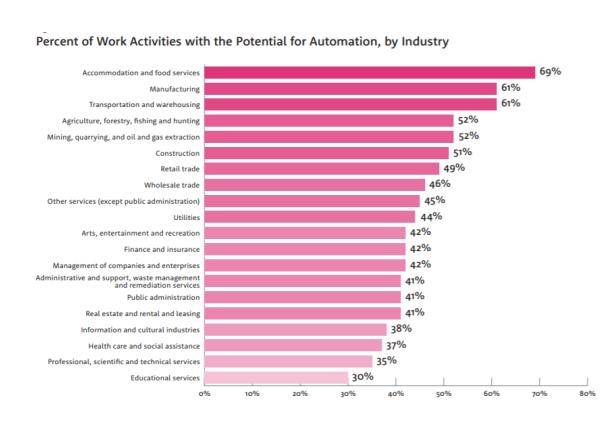
While many would like to believe that automation will only disrupt low-skilled, low-paying jobs, 42% of the Canadian labour economy does not consist of these occupations, meaning medium-to-high skilled workers also face some risk. As computing power and access to big data increases, algorithms designed by engineers can even automate non-routine tasks, so long as they fit within the parameters of a well-defined problem (Autor, Levine, & Murnane, 2003). For example, if we program a machine learning algorithm with the well-defined task of maximizing return on stock market investments, often they’re able to generate much higher returns than human fund managers. Regardless of their years of experience, skill, or training, machine learning algorithms can analyze the relevant patterns and variables needed to make decisions much faster and more accurately than managers can. Investment management companies such as BlackRock, Bridgewater, and Two Sigma have already begun exploring the capabilities that machine learning algorithms can offer. Hardly anyone would disagree that fund managers are a high-skill, well-compensated occupation; but regardless, they too face a medium-to-high risk of automation. Chui, Manyika, and Miremadi (2016) found that even factors such as job salary are a weak predictor for an occupation’s potential to be automated, contrary to our intuition. Even for highly creative and skilled professions such as a CEO, as high as 20% of their activities can be automated by existing technologies, which is higher than even low wage jobs such as care aides or landscapers (Chui, Manyika, & Miremadi, 2016). We haven’t yet come up with robots who can help us with our multitude of daily chores. Still, it’s possible to create automated dashboards that track status reports and company metrics rather than delegating analysts to generate daily reports for us.
Other examples of high-skilled jobs at-risk for being phased out are accountants and administrators in retail. About 53% of tasks in retail consists of gathering customer information, auditing inventory, or maintaining sales records - all tasks that higher-paid workers such as audit clerks, bookkeepers, and accountants do (Chui, Manyika, & Miremadi, 2016). As opposed to lower-compensated salespeople whose job it is to provide product advice and an excellent social experience, it would be more cost-efficient to automate the tasks of the higher-skilled workers (Chui, Manyika, & Miremadi, 2016).
Reports are finding that the majority of occupations will experience an overhaul in skills they require, forcing Canadians to upgrade or re-tool to stay competitive (RBC, 2018). However, just because specific tasks or occupations have the potential to be completely automated, doesn’t necessarily mean they will. Other factors affect the likelihood of automation for certain professions besides the availability of technology to automate underlying tasks. Chui, Manyika, and Miremadi (2016) found three other critical factors which affect automation:
- The costs to automate. Are the costs involving the development, deployment, and integration of AI into business or system processes justified for the often steep prices they demand?
- Supply vs. Demand. The scarcity of skills involved in automation and the relatively low costs and high supply of workers. With all the constant changes in technology, there isn’t enough supply of workers with the skills to develop, deploy, or maintain the existing technologies. There’s also a steep curve in the ability and effort to attain the competencies required for high-skilled occupations, such as a nurse or lawyer. This steep curve works in favour of workers, especially in less developed countries such as Vietnam or Cambodia, where companies often outsource work at reduced prices. Here, a high supply of workers requires less compensation than equivalents in developed countries, often meaning higher productivity from companies; ignoring the ethical labour issues this poses. The costs of labour may be low enough for businesses that they may be willing to forgo the steep expenses of automation in favour of human employees — for example, hiring factory workers in Sri Lanka rather than building factories of machines in North America.
- The benefits of automation beyond labour-cost substitution. To put this simply, would society be ok with robots taking the place of human nurses or doctors? What about having food and beverage vending machines at a sports bar over bartenders or waitresses? Probably not, but time will tell.
DIII - Chapter 9: Adaptability and change
While these findings cause legitimate reasons for concern, as a society, we have lots to benefit from increased automation. For one, automation and machinery remove humans from exposure to hazardous environments, such as the toxic chemicals that are common in manufacturing plants. Truck drivers are another example of workers in hazardous environments. Truck drivers are another example of workers in hazardous environments as they often face issues of obesity and sleep deprivation from years of routinely driving 10-12 hour days (Yang, 2018). Removing human workers from hazardous environments has its glaring benefits for everyone. For one, the individual workers and their families would benefit from avoiding implicit costs such as stress, finances, or time, that hazardous environments bring to their long term health. Not only that, but businesses would also benefit by avoiding the public, legal, or financial ramifications that a critical workplace incident brings. Lastly, a portion of taxpayer money would also be freed up from subsidizing employment insurance or healthcare costs, towards more efficient or progressive projects.
Secondly, as consumers, we’ll have greater access to cheaper and higher quality products as AI-powered automation can do particular tasks at near-superhuman levels (Chui, Manyika, & Miremadi, 2016). Essential goods like food, clothing, and medicine have the ability to become more accessible for lower-income people globally, so long as the means of distribution are in place to equitably share these benefits.
Various workers also see automation as a way to augment human abilities, rather than replace it altogether. People in occupations requiring a high degree of creativity, interaction, and problem-solving find a boost in their productivity and human abilities when they’re able to successfully leverage technology (Autor, Levine, & Murnane, 2003). Since Transformational-Servant Leaders advocate for the growth of their people and society’s overall well-being, it’s clear that adapting our people alongside automation is the path towards collective prosperity. Fittingly so, adaptability and change is also a competency within the framework. Transformational-Servant Leaders must be “open and responsive to personal change” and willing to adapt their organizational strategy to dynamic situations (Leadership Integration Project Manual, 2015, p. 7-8).
To recap our findings, earlier, we mentioned that 5-9% of occupations had the potential to be completely automated, while 42-47% face some risk of being affected. The good news for leaders is that workers in occupations within that 42-47% range have the potential to successfully integrate alongside automation, by retooling their skills and shifting away from tasks that will get automated. The key is to understand which skills will advance both the organization and employee’s abilities, while concurrently removing the inefficiencies. For those in the 5-9%, leaders need to educate them on the changes ahead, provide them with the means, and empower them to make a complete career pivot.
One significant finding from RBC (2018) reports that all Canadians in the upcoming decade will need to possess at least some level of digital literacy. This doesn’t necessarily mean that everyone needs to know how to code, but that workers are familiar with utilizing a computer or mobile software in their daily work. Not only will workers need to adapt their skills to business needs, but leaders should also foresee changes that can take place within their business processes or market dynamics. Having a roadmap that integrates automation will only help leaders and their organizations stay competitive for what’s coming; and in doing so, can collaboratively evolve their people alongside the organization. Transparency, open communication, and inclusion into long-term organizational growth will spur loyalty and buy-in from employees, thus allowing organizations to remain competitive in the foreseeable future.
However, the movement towards adaptation must first be recognized, then initiated by leadership teams. To put into perspective, there’s no sense in employees adapting their skills if their organizations don’t evolve to utilize them. Leaders need to set a clear vision as to how their organizations will integrate AI and more efficient processes, then develop personal action plans for those wanting to take part in the collective growth, thus increasing the skills and human capital for those within the organization.
We’re beginning to see an increasing demand for skills in the labour market, which help businesses leverage technologies such as artificial intelligence, big data, or cloud computing. Companies are continually looking for ways to gain a competitive edge amongst their competitors by making smarter decisions, reducing inefficiencies, or adhering to progressing social and environmental standards. Conceptually, this makes sense as dynamic business needs place a higher premium in professionals that help them attain growth. On the other hand, lesser valued occupations or skills are slowly phasing out, representing the natural order in the supply-and-demand relationship between labour market supply and institutional demand. Using a combination of Canadian growth in job postings and salary data from 2014 to 2017, Indeed’s Senior Vice President D’Arcy (2018) and his data science team compiled a ranking of the top occupations, with the best combination of job growth and salary:
Table 2. Ranking of the best jobs in Canada: 2018
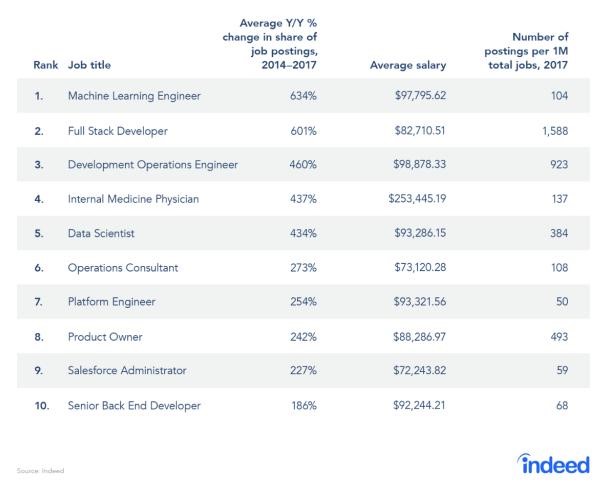
Looking closely at these rankings, 9 of the 10 occupations on this list relate to tech, with “Internal Medicine Physician” here being the exception (D’Arcy, 2018). Data from LinkedIn also support these findings as they compiled a list of the most in-demand skills on their platform and found that 17 of the 25 hard skills they listed involved mastery over a specific technology (Petrone, 2019).
As you’ve probably deduced in the research I’ve compiled so far, I’m passionate about everything AI and the possibilities it can bring to the organizations that harness it. I believe that organizations that can adapt by combining the ingenuity of human intuition with AI-generated insights will be the ones that distinguish themselves from their competitors. As a society, we’ll be able to augment our abilities on a scale, unlike any other in human history by harnessing artificial intelligence. The possibilities are endless for what this technology can contribute to, whether that be understanding and curing cancer, building autonomous drones used for atmospheric carbon-capture, or neural-connected sensory prosthetics. Think about it, these are only the applications of AI within our current realm of imagination. What about those outside of it? Looking back just 20 years ago, who would’ve imagined that all-purpose, touch-screen cell phones would be so essential to our personal lives? In the next chapter, I’d like to share my ambitions for adapting my skills within the age of artificial intelligence and partnering with organizations that share my core values.
Chapter 10: My journey towards Data Science and Machine Learning
As an aspiring Transformational-Servant Leader dedicated to helping others fulfill their potential, I don’t see any other choice for myself but to be at the forefront of this revolution. If I want to live out my mission statement, then learning, understanding, and using these tools will be essential to addressing today’s problems. After completing my Master’s program, I’ve decided that the next step in my journey will be to attain proficiency in the complex space of Data Science and Machine Learning.
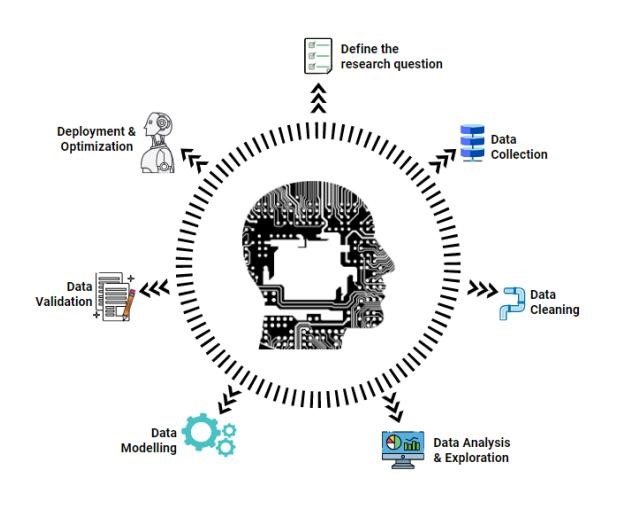
For those unfamiliar, Data Science is a field within the overarching realm of artificial intelligence. It is one of several domains that’s emerged in popularity in the last decade from the explosion of data. The scope of what encompasses Data Science is still loosely defined as the activities that comprise it are still so new and dynamic. In this chapter, I want to go over how AI-related fields, such as Data Science, will revolutionize the conduct of business, research, and science. This section will briefly describe the activities which make up a typical Data Science project, as illustrated in the image below. Providing an overview of how certain practices have capitalized on technological disruption may offer more in-depth insight into the potential of this new age to change the nature of work forever. Data Scientists will most certainly be one of the key players in both driving and understanding the full extent of AI automation.
To be more precise, Data Science is a multidisciplinary field that combines the fields of statistics and computer science to leverage data for purposes such as visualizations, analysis, predictions, or pattern recognition (University of Waterloo, n.d.) Data Science techniques can serve various purposes in industry or research, from analyzing, modelling, and then predicting customer data to drive business decisions; to understanding the behavioural patterns of a new drug as it moves through the human body.
There are several reasons why both Statistics and Computer Science are imperative in Data Science. For starters, Data Scientists seek to leverage the plethora of information on the web, using various computer science techniques, to acquire or scrape the data needed for analysis. Obtaining the data is the first step of a typical Data Science project cycle (Lateef, 2019). Sometimes this process may be as simple as scraping it internally from the company’s database. Another method may be to acquire it from repositories on the web, such as GitHub or Kaggle.
Political or marketing firms are an example of firms that will buy data from brokers or third-party companies that generate clean datasets from their platforms to understand their target population’s behaviour. What I mean by “clean” datasets in this instance, are large datasets that are accurate, often labelled, and display the variables that companies are looking for. These datasets contain consumer information such as age, general location, phone number, the time they spent viewing an online product or webpage, the time of day they accessed they accessed this information or their broad interests. There’s a saying these days that “data is power” because of the immense value they drive in understanding consumer’s innermost desires, which is an ample reason why big data companies such as Microsoft, Google, Facebook, and Amazon are titans of the corporate world. Buying or accessing free data is by no means an exhaustive list of ways to acquire data. There are many other creative means of acquiring it as if it were a currency in a fully circulating digital economy.
Once the data is acquired, Data Scientists then allot a large portion of their time and computer science skills on “data cleaning,” which is essentially refining the data so that it fits within their model or analysis. It’s still common for Data Scientists to “clean,” repurpose, manipulate, or transform purchased data so that it fits within their model or business problem. This process is the most time consuming as it often involves programming scripts or other tools to systematically remove or manipulate data for the project.
After the data has been “cleansed,” the most crucial step then takes place, where Data Scientists must use statistical reasoning to find trends or patterns in the data. This exploratory phase is where we begin to see raw values transformed into compelling insight in which Data Scientists use to form their hypothesis, determine the relevant variables, build and program their model, and then test its validity and reliability.
The last and most impactful step will be to communicate the project’s findings to stakeholders and decision-makers by creating a data visualization. To put it simply, a data visualization is a medium, such as a graph, chart, map, or dashboard, that presents patterns found in data to an audience in a meaningful way (University of Waterloo, n.d.). The adage that “a picture is worth a thousand words” remains relevant to data science as well. With some projects, the visualization is the final deliverable for the end-user who would then use the tool, if constructed adequately, to make decisions or advise a course of action. Some end-products may be interactive or dynamic, providing real-time updates to variable changes. Others may be static, such as traditional charts, graphs, or infographics.
If the clients or stakeholders choose to proceed past the communication or visualization stage, Data Scientists then start working on optimizing their model’s efficiency, training their datasets, and then deploying it for production. The optimization stage is typically relevant if the client asks for a specific product to preform some sort of artificially intelligent function. This is where Data Science and Engineer teams utilize computer science-heavy machine learning, or deep learning, to build “simpler” products such as a video recommendation engine or a stock price predictor.
Examples of more advanced products that Data Scientists and Machine Learning Engineers could undertake include image classification systems to distinguish people or objects in CCTV cameras or a photo database. Another advanced project could be to utilize natural language processing (NLP), which uses voice or language data to build products related to speech recognition, natural language understanding and generation. The end-result for NLP projects could be voice assistants, or more maliciously, Deepfakes, which uses a combination of language data (and/or videos depending on the project’s purpose) to create audio samples which realistically imitate anyone’s voice. Typically, high-profile celebrities are often the best targets for creating Deepfakes since there’s plenty of video and audio data out there to work with. As an example, one of the most powerful leaders on Earth has become a popular (and frankly, alarming) target for Deepfake creators to imitate, either through video or audio samples, is the current American President, Donald Trump. These applications of machine learning form the underpinning of AI that we see or use every day and may also be one of the crucial dilemmas we’ll see in the future.
For myself, mastering machine learning has now become my passion moving forward as I see it’s potential to augment our human abilities and uplift others for the better. I believe that the more people who come to terms with AI’s impact on our society, the better chance they’ll have to capitalize on it. Undergoing this journey myself will represent my path towards the evolution I’ve described that we must all undergo. Through my journey, I not only want to improve myself and evolve as a person but also lead by example and inspire others that they too can grow and adapt to the circumstances that time has befitted us. Often, people describe leadership as an ‘art,’ something I’ve been honing for the past year and a half through this program. Now, my ambition is to round out my leadership education by learning and mastering the science of Machine Learning, balancing art hand-in-hand with science and thus putting me in a better position to fulfill my personal mission.
DIV - Chapter 11: Innovation
Counter. One of my favourite words. Counter, I would say, is the all-encompassing word that represents my philosophy when encountering opposition. This word can be used interchangeably with other terms such as adapting, learning, re-inventing, or innovation. Learning is another one of my favourite words and compliments my use of “counter.” In this instance, I’m referring to counter as a noun: “A statement or an action made to refute, oppose, or nullify another statement or action” (Counter, n.d.). Another definition that comes to mind when I think of “counter” is “a blow delivered when receiving or parrying another blow, as in boxing” (Counter, n.d.). Boxers like Manny Pacquiao will often squeeze out victories against stronger opponents by analyzing their behavioural patterns, then countering with decisive blows twice as powerful when the opportunity presents itself.
The reason why I’m talking about this is that I believe the ability to counter, learn, or adapt to one’s circumstances will be integral to their success. Despite what analytics or experts say, no one can predict what the future holds. As much as we may try to plan so that we influence specific outcomes in our favour, the world has a funny way of throwing curveballs at us where we least expect it. However, the one thing we can control without a doubt is our actions and attitude. How do we best utilize the poker hands that are dealt to us or adapt to the actions that our opposition throws at us; whether this be from our rivals or just plain bad luck.
Countering automation will require organizations to excel at quickly learning on-the-spot and then acting, whether this involves reiterating their existing products to meet dynamic consumer trends or instilling a new mindset in employees. Teams that continuously learn and adapt to their surroundings become dynamic, fluid, and unpredictable to their adversaries. From a competitor’s standpoint, there is no way to strategize against teams like this because they ultimately have no gameplan to scheme against; these teams take what they’re given and make the best of their situation. In this way, leaders and their teams don’t just react to unpredictability but instead become one with it.
Personally, there’s a saying that I keep reminding myself whenever I encounter an especially unfavourable situation: “Make every experience a learning experience.” By reminding ourselves of this perspective, then nothing negative ever happens to us because every mishap is simply another opportunity to improve. In doing so, our psyche remains positive, and we feel as if our realities are within our locus of control. With this mindset, there will never be a reason to get down on ourselves. Everything we do or experience, no matter good or bad, becomes part of our evolution.
In fact, the common phrase: “Failure is life’s greatest teacher” resonates with history’s greatest figures. Many people, athletes especially, recall Michael Jordan’s famous saying: “I’ve failed over and over and over again in my life, that is why I succeed.” In his quote, Michael Jordan implies that he is the product of his failures. However, taking this saying literally and failing for the sake of failing isn’t what leads to success. Albert Einstein would say this is “the definition of insanity, doing the same thing over and over again and expecting different results.” No, what separates greatness is learning from our mistakes and modifying our behaviour to create a different outcome.
As a leader, instilling the mindset of constant growth through understanding how to read, adapt, and counter situations will be paramount to building an organization that adapts to automation. We can relate the circumstances ahead of us with Darwin’s theory of biological evolution over time. To briefly summarize, Darwin’s theory of evolution argued that the species we see today were able to adapt to their environment and pass on their successful genes/traits to the next generation, also known as natural selection (Kilpatrick, 2019). Although a central pillar to evolutionary biology, aspects of this idea also reveals itself in business as well. As Simpson (2019, para 1.) wrote in his article detailing companies that have successfully adapted over time, “adaptation and survival go hand in hand.”
Just as how our society’s greatest visionaries continue to push towards the constant evolution of their technologies, so too can organizations be viewed as potential innovations on the cusp of reaching greater heights. Innovation is the last competency within the Transformational-Servant Leadership framework that aligns with this universal need. According to Mitchell et al. (2017, p.52), innovation manifests within Transformational-Servant Leaders when they’re able to discern business opportunities and carry them forward, generate creative ideas, take an innovative approach to problem-solving, think “outside-the-box,” have the willingness to try unconventional solutions, and lastly, champion innovation and new ideas from employees; especially pertinent to those at the Senior Executive Level and beyond. Applying creative solutions so that an organization as a whole will be able to counter the effects of automation is a competency that Transformational-Servant Leaders are best suited for.
As I’ve alluded to earlier, the individual ability to perceive a potential threat and then learn, react, or counter it quickly will be crucial to our adaptation with automation. Now the biggest challenge for the aspiring Transformational-Servant Leader is: How can we scale up the behaviour, mindset, and skills necessary for evolution up amongst our organizations? Well, from my research so far, the short answer I’ve found to this is to build a “culture of learning,” or else known as a “learning organization.” In the next chapter, we’ll begin painting a rough picture of what a learning organization entails to help leaders achieve this vision.
Chapter 12: Learning organizations
Senge (2006, p.8) wrote extensively on this topic (an entire book in fact) and defined learning organizations as those “where people continually expand their capacity to create the results they truly desire, where new and expansive patterns of thinking are nurtured, where collective aspiration is set free, and where people are continually learning how to learn together.” I also share a similar sentiment with Senge (2006) that for organizations to sustain a competitive advantage, they must be able to learn faster than their competitors.
Now take a guess at the most basic, most fundamental aspect of a learning organization? That’s right, it’s people. Learning organizations must have people who either have an innate desire or are encouraged by their peers to learn continuously, so much so that it’s embedded within the very roots of their culture. Not coincidentally, the TSL framework aligns with this philosophy in that it argues that a leaders’ central motif is to serve people so that they reach their full potential and will result in the transformation of an organization; and to a broader extent, society. Transformational-Servant Leaders building a learning organization must, therefore, encourage their people to integrate learning as a life-long discipline. Not only must people be encouraged to be lifelong learners, but more crucial to that, Transformational-Servant Leaders must also embolden a personal vision, and then find ways to align that with the organization’s mission, vision, and values.
This point relates to the previous discussion in the foreword where a personal vision of your future self or an individual mission is like the spirit that defines your sense of life purpose. Vision is what ignites the flames of passion towards the journey of transforming into our idealized selves. Leaders who ignite these processes then convey learning as a means towards that end, a tool in the journey. Without that disconnect between our present selves and our idealized state, learning does not exist within the realms of self-improvement, which is all the more reason for inspiring a personal vision in the first place. For Transformational-Servant Leaders to maximize their people’s potential, they must collaborate with them in terms of building the vision for what that potential is to strive for it. In realizing that purpose and then aligning it within a shared organizational vision, leaders consequently lay a solid foundation for a learning organization.
Once that fire for passion, life-long learning, and self-improvement has become part of our psyche, the next stage of building a learning culture is mastering team learning. Referring back to Senge (2006), team learning is where group members can suspend their previous mental models or schemas to engage in free-flowing dialogue which contributes to a greater intelligence. These conversations are the perfect balance of inquiry and advocacy where members can communicate their thoughts, while simultaneously allowing themselves to be influenced by others (Senge, 2006). Achieving team learning however, first requires the group to have a clear vision of what they want to achieve collectively as well as the unrelenting commitment from each individual. Unifying under a shared vision, plus setting aside personal egos and then sacrificing for the collective well-being, are the ingredients necessary for achieving team learning, especially for groups with an abundance of individual talent.
Now the last stage of organizational learning, which synergizes with team learning nicely, is for an organization to engage in systems thinking regularly. In the context of organizations, by “system,” we mean a highly integrated series of subsystems, roles, or individual parts synchronizing to accomplish a goal. With social systems, we can imagine mechanisms of economic systems, such as interest rates, which influence business activity. Or mechanical systems, such as the mechanical makeup of a car, that affects the speed, horsepower, and energy efficiency of the vehicle. Or else, the biological interaction between muscles, bones, and nerves, which influence bodily movement.
Senge (2006) argued that when an organization engages in systems thinking, a group can collectively address problems to deep-seated issues more effectively. This idea stems partly from systems theory, which poses that accounting for a system’s complexity requires an examination of the interaction between the system’s moving parts (Lalande & Baumeister, 2019). This idea opposes the previous notion of reductionism put forth by researchers that examining something requires studying a system’s individual parts in isolation (Lalande & Baumeister, 2019). Rather than blaming problems or inefficiencies on isolated instances, such as leadership styles, personnel, or significant events, learning organizations must instead address the structural roots of these issues, or in other words, the system. By addressing the root cause, teams will be able to provide a permanent solution to an ongoing concern rather than putting out the fires associated with that systemic issue. It’ll be like finding the leak in a pipe and replacing the damaged metal rather than placing a bucket under the leaking. In doing so, teams will learn to be more efficient at investigating the causes of these issues, rather than blaming each other for their incompetencies.
A poignant example of when I would make this mistake of thinking linearly, instead of systematically, was in my youth whenever I meandered in the Downtown area of Victoria, B.C and internally condemned the homeless for their failures. While it’s not to say that their individual behaviour did not play a part in their life circumstances, but as I grew older, I learned that there were much larger forces that contributed more to this. For example, looking at the majority of Indigenous people in poverty, I realized that one of the major events which contributed to the multi-generational destruction of their cultural and economic well-being were the residential schools mandated by the federal government.
Through their passing of the Indian Act in 1876, the Canadian Government essentially legislated the cultural genocide of the Indigenous population (Miller, 2019). With this Act, the government mandated that a total of 150,000 children, within the span of over a hundred years, to attend these schools and assimilate white, Christian, “Canadian” values (Miller, 2019). The unimaginable horrors from this policy decision resulted in parents separating from their children, never to see them again. While at Residential School, the Indigenous children were forced to kill off their cultural values and assimilate with white, Christian values, often through means of violence, rape, and abuse (Barber, 2015). The effects of these schools still appear today as it resulted in the destruction of an entire generation of Indigenous people and the death of roughly 3000 children, many of whom undocumented (Barber, 2015).
I , too, have felt the damage these events years later through my work and interactions with the Indigenous community here in Vancouver. I’ve heard the stories of pain and suffering in this community, especially from those who inherited these misfortunes from parents who attended residential schools. As a result of the trauma many of these children went through, their adulthood became entrenched in drugs, alcohol, violence, and victimization; later on, passing this way of life to their children. I can’t even begin to imagine what it would be like to grow up in communities, such as Indian reservations, where it was normal for families to drink frequently, use drugs at the dinner table, and regularly endure abuse. For those of us more fortunate, this world does not exist within our realms of understanding. This ignorance is why it’s easier to blame these people for their present, surface-level deficiencies. For the populace of poverty-stricken Indigenous people, these social, economic, and political factors widely contributed to their lower socioeconomic position.
For an individual or an organization bent on addressing this systemic injustice, providing basic needs to these people like food, water, clothing, or shelter is only a band-aid to the deeper issues on-hand. Of course, it’s paramount to support this community’s basic needs, but if we want to make a more profound difference, then addressing these systemic forces will be more impactful. Addressing systemic issues could involve advocating for further resources from the government, supporting grassroots organizations, or investing more in Indigenous education as a way to permanently improve their social mobility
Although we’d often like to believe that everything in our environment is the product of our behaviour, often this isn’t the case. Leaders or managers in the workplace sometimes tend to think that they can solve most problems through simplistic, linear solutions. For example, as a manager, you may notice an issue with the workplace culture that’s causing wide-spread employee dissatisfaction. Employees may be feeling burnt out by the pressure and workload that management places on them, which should signal talks of expanding the organization. A linear-thinking manager might instead be inspired to buy lunch for the team or grant a bonus at the end of the month, thinking this solution will lead to an increase in employee morale. While this may help for a couple of days, sometimes the problem runs far deeper and may continue to linger or worsen if it isn’t adequately addressed. Perhaps the company’s compensation rates aren’t as competitive relative to the industry, leaving talented individuals searching for greener pastures or effortlessly snatched by rival recruiters. As a result, this instead may be a significant cause of the heavy workload and low morale for the remaining employees. As a leader, or even as an employee, it’s important to understand and consider the interplay between systematic social, political, and economic forces when evaluating situations. Sometimes addressing that surface-level issue is all that it takes to solve the problem. However, it’s always good practice as well to consider the systemic problems
Leaders who seek to maximize the potential of their people must instill a mindset among their teams of educating themselves on the presence of these systemic influences and their effects. Broadly speaking, these influences involve political decisions from the government, which might affect the business landscape, international policy developments for organizations reliant on foreign stakeholders, economic activity as dictated by key industry players, or changing cultural trends and values. To signify its importance, Senge (2006) even keyed in systems thinking as the cornerstone for learning organizations due to its gravity in spurring, both individual and organizational, continuous learning.
In general, implementing a culture of continuous learning is a never-ending quest for many forward-thinking leaders or HR managers. Organizational learning in itself is a complex, multidisciplinary field that draws on research from psychology, sociology, economics, business management and more. Not only should leaders advocate for instilling or hiring people with inquisitive characteristics within their teams, but also generate an organizational strategy for dealing with uncertainty. Hughes and Colarelli-Beatty (2005) expand on this idea as well by proposing that organizations should embed the learning process within organization strategies, rather than building traditional and comprehensive step-by-step plans. As the name implies, the critical component to this strategy is to have people who drive their learning engine forward (Hughes & Colarelli-Beatty, 2005). To quickly summarize a book’s worth of theory, Hughes and Colarelli-Beatty (2005) proposed that organizational strategy should broadly take on five key stages:
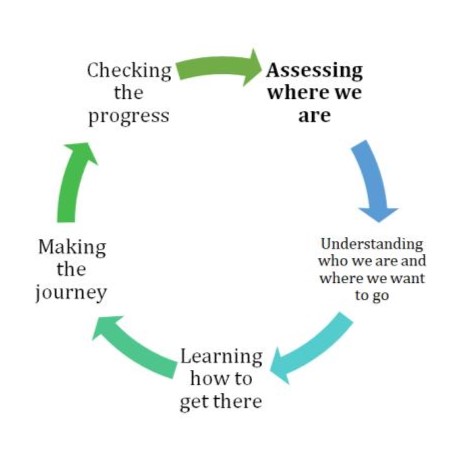
In structuring corporate strategy as a learning process, organizations create emergent strategies and adequately react in real-time to unpredictable situations. Leaders will also find tangible improvements, such as an increase in their innovation cycles as an example, bringing products to market faster, or quicker reactions to emergencies. However, to do so, leaders must encourage an environment of innovation where experimenting is the norm and failure occurs as a productive exercise. Only through experimentation, trying new things, and testing their consequences within the dynamic world can people or organizations innovate. In this way, learning becomes an active process of accumulating knowledge through interacting within the environment rather than being detached from it through passive learning. Learning, insights, breakthroughs, and innovation doesn’t just have to come from surroundings we regularly interact in, but from everything around us. To practices from different industries, processes observed scientifically in nature, movies and T.V shows, insights from scholars or loved-ones, we can use anything and everything to generate new knowledge. My childhood idol, the late Kobe Bryant, influenced me with this perspective on innovation which led him to greatness, both within sports and even in film after he retired:
Basketball, for me, was the most important thing. So everything I saw, whether it was T.V shows, whether it was books I read, people I talked to, was done to try to learn how to become a better basketball player. Everything. So when you have that point of view, then literally, the world becomes your library to help you become better at your craft (Bet-David, 2019).
By intertwining experimentation, innovation, and learning into strategy, organizations are setting up the most crucial aspect of a “learning organization,” which is to act by changing or modifying their behaviour on newly-acquired insights.
Garvin (1993) takes this a step further by arguing that rather than offering grand theories of organizational change to business leaders, scholars should instead focus on specific approaches that are more easily implemented by management teams. To do so, Garvin (1993) suggested that scholars or consultants focus on the 3M’s when advising leaders:
- Providing well-grounded definitions, actionable strategies, and meaning to each of their propositions;
- Providing management with clear-cut guidelines for these actions, practices, or operational procedures;
- And lastly, providing clear, reliable, and valid measurement tools that assess the progress of goals, which in this case, is organizational learning.
Gavin’s (1993) notable suggestion was for organizations to have a systematic way of solving problems, similar to the scientific method. This idea is also comparable to the analytical process data scientists use when addressing a specific business problem; and also conceptually intersects with the idea we mentioned earlier of strategy being a learning process. To apply the scientific method to a business-use case:
- Teams must observe or flag the issue and establish a well-defined business problem with a clear vision of what they want to achieve;
- Generate a hypothesis or a solution for diagnosing the problem to develop a direction for the analysis;
- Gather data to test the hypothesis, using the original business problem as a guide for finding the variables connected to the business-use case;
- Synthesize and analyze the data to determine whether it supports or rejects the proposed hypothesis;
- Communicate these results to decision-makers and take action, feeling confident that the resulting outcomes were data-driven and grounded in sound logic.
Knowledge acquisition, retention, and deployment are what will help organizations grow and continue to innovate. Finding new inspirations for ideas must come from everywhere and solving problems will continuously require new skills, methods, or frameworks of thinking. That said, nobody knows the challenges associated with their job better than the employees who must address them. Yet, with most companies, the responsibility of employee development is often delegated to HR departments who’ll likely roll out the generic, company-wide classes, seminars, or training that may not even be relevant to the individual’s needs. Therefore, when it comes to individual learning and growth, I believe that leaders should instead empower their people to seek growth for themselves and merely provide the support to attain it. That support could be emotional, motivational, or the financial means for employees to obtain growth. Growth can manifest when leaders provide employees with more ownership over tasks that require creativity and abstraction to complete them. It could also mean assigning employees to work teams and task forces that address the organization’s long-term future, or allocating work hours for self-paced learning. Learning new skills is now easier than ever with the growing amount of free or low-cost online learning platforms such as Coursera, DataQuest, Google Academy, EDX, MIT OpenCourseWare, Udemy, or educational YouTube channels. Coupled with the fact that many universities are now expanding their reach to broader audiences through distance learning, education has never been more accessible than it is right now!
The tools are all there, the question is whether leaders can motivate their people to grow to their full potential; and by extension, the organization’s capacity. Peer-reviewed studies have widely supported the notion of encouraging individual growth, either through internal training or external learning platforms, resulting in increased organizational capacity and innovation (Rhoades & Eisenberger, 2002; Sung & Choi, 2014). One suggestion I have to this is for organizations to make learning fun and dynamic by gamifying the process. For example, many innovative companies now practice holding “Hackathons” where multidisciplinary groups, especially programmers, compete against others to achieve a given task the fastest or most effectively, such as hacking a secure network or quickly building a machine learning algorithm with a given dataset. Another way could be to provide individual recognition, such as a leaderboard, for every time an employee completes a certain number of certifications or courses within a given timeframe. But again, motivating people will still require a TS Leader to form a path by building that personal vision we discussed earlier, and then providing them with the means; whether it’s time, funding to access these platforms, or gamifying the learning process.
DV - Chapter 13: Implementing a TSL-based Learning Culture
In the previous chapter, we discussed several ways for Transformational-Servant Leaders to prepare their people for the changes that automation will bring to the business landscape. The recurring theme in the literature was that people must continuously sustain a learning mindset as society evolves. Leaders can do their best to motivate and promote an inquisitive, learning culture in their organizations, but ultimately, that thirst for knowledge and drive to succeed start and end with the individual. In these last few chapters, we’ll take a closer look at methods of building learning cultures, as well as organizations who’ve mobilized their employees to adopt a growth-based mindset, thus increasing their skillset and value. Implementing a learning culture isn’t difficult; it merely starts with the commitment to become a better version of ourselves, and then relishing in the journey towards our personal growth! Once we’ve made that commitment towards our transformation, we’ll naturally emit a mindset, attitude, and positive energy that takes root in others who are ready themselves to change. Several cultures have used variations of this type of energy as foundations for spiritual practices, such as with “mana” in Hawaiian mythology, “qi” or “chi” in Chinese, or “chakra” in Hinduism. From these inserts, I hope that aspiring Transformational-Servant leaders will use these lessons to incite substantial change among their people, and drive them to increase their value continually; both to their organizations, and by extension, to society.
While it’s true that adopting new technologies can spur an immediate competitive advantage, over time, competitors will find a way to level the playing field. For this, let’s return our discussion to the technology that’s the main subject of this publication, artificial intelligence. It’s a common trap among business leaders to believe that adopting machine learning and artificial intelligence is a magic wand that augments organizational preformance. With all the media hype in the business community surrounding this new and exciting field, it’s hard not to blame them for thinking so. However, without fully understanding an AI system’s full capacity or the processes in which it produces insight, leaders will be limited in their ability to make smart decisions, thus rendering the technology ineffective.
Often, early adopters of AI will find themselves at an advantage early on as the sole providers for an innovative product or service in the market. However, as companies recognize the benefits of adopting this technology, more of them will follow suit, thus levelling the playing field. An easy example to point to is Apple’s breakthrough in the mobile tech space, with its invention of the iPhone and iPad. As a result of their success, other companies, such as Microsoft, Google, or Huawei, entered the fray by offering their versions of the same technology. Technology in itself isn’t going to preserve that competitive advantage because competing companies will always find a way to reproduce it if the incentive is high enough. The X-factor for leading companies will always return to the human capital that their people produce, and by marrying sound reasoning with data-driven evidence. Employees who can use the levelled technological playing field to make smarter decisions, come up with new ideas, understand tech-related biases, and think critically, will be the ones to pioneer new possibilities and power their teams to success.
To understand how a company’s employees can pioneer breakthroughs amongst their competition, we must provide a brief explanation of the human capital theory and how it contributes to economic progress on several levels. Human capital is a central tenet to economic theory, which posits that the sum of an individual’s unique characteristics, such as their work ethic, experience, creativity, or sociability, contribute to their firm’s overall success (Flair, 2019). Similar to what TSL theory promotes, the success of an organization depends on the efficiency, growth, creativity, and production of its employees, i.e. it’s human capital. From a macro perspective, human capital is also directly tied to the growth of local and national economies, since it represents the talent and economic output that individuals contribute (Abel & Deitz, 2011). For example, one of the most significant issues plaguing less-developed countries is their “brain drain” of talented individuals. These professionals will often leave the instability and corruption of their home countries to pursue more lucrative opportunities elsewhere. The same principle applies to organizations with incompetent work environments, but instead, in the form of employee turnover, more of which we’ll discuss later.
Business leaders conceptually understand this and are incentivized to maximize their human capital by acquiring, managing, and cultivating talent that will increase the organization’s value (Flair, 2019). Depending on the outcome their organizations are trying to produce, leaders will assess human capital by valuing specific skills over others (Flair, 2019). For example, executives looking for middle managers will value candidates with more industrial domain knowledge and general sociability to manage others. In contrast to business leaders, hospital administrators seeking social workers will instead value people with higher emotional IQ and a dedication to social justice.
Transformational-Servant Leadership is tied directly to maximizing human capital because it emphasizes fulfilling its people holistically, in ways besides their direct contributions to work; such as personal development or their family’s well-being. Leaders who practice Transformational-Servant Leadership will recognize the numerous factors which contribute to cultivating human capital, not just the ones they see within the workplace. By investing in human capital through means of generous health benefits, dynamic work environments, or coordinating tasks with personal interests, employees will multiply their organizational value, thus yielding a positive ROI. In essence, maximizing human capital is the pragmatic concept that captures Transformational-Servant Leadership’s underlying objective.
Throughout history, learning and intellectual curiosity have always been salient to gaining a competitive advantage. Studies have denoted that education is closely linked to increasing human capital, and leads to increased organizational value (Abel & Deitz, 2011). Therefore, organizations that can leverage these values will stand above their competition, despite disruptions to the industry. Nobel-winning economist, Chevalier and his colleagues (2004) support this notion by finding that increased education leads to increased worker productivity. Despite the compelling argument that many employers may, instead, be using education as a signal of higher competency and intelligence, there is a real effect of increased human capital on organizational productivity (Chevalier et al., 2004).
With that said, one of the best ways for organizations to multiply their people’s human capital is by investing in their growth through further education. Empowering people to educate themselves further comes with a plethora of benefits, not limited to gaining fresher insights outside of their typical environment, creating networking opportunities, or upgrading their skills. There’s also a financial incentive for companies as they often receive tax breaks when they provide partial reimbursements of around $4000-6000. Best of all, a systematic investment into an organization’s human capital will strengthen an employee’s engagement in the company and equip them to take on higher-level leadership roles (Benson, Finegold, & Mohrman, 2004). Education will be the safeguard preventing both employees, and their organizations, from experiencing the technological disruption of routine, non-cognitive work.
Further education is especially crucial for organizations participating in the knowledge-based economy since employee loyalty is often a massive component of organizational success. From the moment they start working with a company, employees accumulate human capital and value for their organizations over time, as they develop the expertise to fulfill their roles efficiently. From the information they shared, to the speed at which they completed tasks, to their unique interaction with other teammates, everything that an employee contributed would disappear the moment they leave elsewhere. As a result, leaders must expend time, money, and energy to replace that employee and train newcomers up-to-speed, thus forfeiting more valuable allocations of those resources. This idea refers to another we touched on earlier with learning organizations, and the intellectual capital they lose during instances of employee turnover.
Investing in an employee’s growth through funding higher educational training addresses many of these concerns. Benson, Finegold, and Mohrman (2004) confirm this when they found that for companies that offered to fund higher education, there was less turnover from employees who took advantage of these programs, regardless of salary. Policies for furthering employee education could come to appear as full or partial tuition reimbursements, time off for self-development, or an agreed-upon educational contract. Manchester (2012) also found an effect of tuition reimbursement programs on employee retention from observing its before-and-after effects, seeing a near 20% increase in retention rates since it’s introduction. The relationship between tuition reimbursement and retention was especially significant for employees who pursued job-related degree programs, as they were 27% less likely to leave within five years of graduating (Manchester, 2012). There could be many explanations for this decreased turnover. We could point to an increased affinity for their employers when they present employees with opportunities for self-development. Another, perhaps, more utilitarian explanation could revolve around a lesser inclination to leave because doing so means forfeiting these benefits and disrupting their studies (Benson, Finegold, & Mohrman, 2004). Moreover, employees who use the funding, in addition to their work responsibilities, will take a significant amount of time to complete a degree. In layman’s terms, this means that the longer they’re utilizing this organizational benefit, the longer they’ll be tied to their organization.
The idea of partially completing a company-sponsored degree program and the time spent in education coincides with a previous concept we introduced earlier, the signal theory. Returning to Chevalier and his colleagues’ (2004) discussion, the signal theory is the idea that employers use educational degrees as an identifiable signal of competency, more so than the actual skills gained or hours spent from such training. As a result, employees who value increasing their attractiveness to the labour market would be less inclined to halt their education, thus forfeiting the benefits that their degree or certification would signal.
Despite all the apparent benefits of adopting such a program, employers still have several reservations for instituting such change. One of the main factors accounting for employer’s hesitation towards approving an educational funding program is what happens after employees complete their education. In his research, Trevor (2001) found that education was also one of the most significant contributors to voluntary employee turnover, along with their cognitive ability and occupation-specific training. The voluntary turnover relates to theories of social mobility, meaning that as employees acquire skills, training, degrees, or certification, generally, the demand for their services increases. By training in academic institutions, employees are expanding a skillset that’s highly transferable and immensely sought after by other companies. Not only that, but employers must also bear the costs of increasing their compensation for employees who have completed their degree program because, in general, their market value has increased (Cappelli, 2004). When employers forego this alternative, they run the risk of losing their employee to a competitor that’s willing to pay the premium for their new skills (Cappelli, 2004). As a result, the temptation to pursue more lucrative opportunities increases, thus dissipating their employers’ investment towards them and defeating the purpose of the program.
However, Pattie, Benson, and Baruch (2006) found that this explanation may only be more accurate for employees who are pursuing studies unrelated to their current jobs, as opposed to those who seek job-related degree programs. Manchester (2012) offered the insight that generally, employees who pursue degrees unrelated to their work means they have a lower affinity for their current job, or may not be as sure about their future career path. This is even more so for employees who complete a graduate degree, as it’s hard to imagine an employee keeping their position as an administrative assistant during the months after they complete their MBA program as an example. Additionally, Benson, Finegold, and Mohrman (2004) find evidence for a 75% likelihood of turnover since the credential broadcasts such powerful signals of competency. Interestingly enough, however, employees who earned either a bachelor’s or associate degrees, through company-sponsored education programs, did not lead to increased turnover (Arkes, 1999).
Another reason for the turnover may be related to the discrepancy between an employee’s current role and the skills they just acquired. To be more specific, employees may seek opportunities elsewhere that their current employer can’t provide, such as increased responsibility, salary, progression, or just the chance to fully deploy their skills. Benson, Finegold, and Mohrman (2004) suggest that one of the best ways to mitigate this risk is through promotion, which alone is one of the most significant determinants of increased employee satisfaction. When an employer offers a promotion shortly after completing their educational program, this signals to the employee that their newly acquired skills are being recognized by them (Benson, Finegold, & Mohrman, 2004). Promoting an employee also validates some of their potential motives for upgrading initially, such as a higher capacity to take on challenging projects, leadership opportunities, or a salary raise. Knowing that promotion helps reduce the probability of turnover, leaders and managers must be selective with whom they grant these benefits and evaluate whether they would be an excellent fit to assume future leadership responsibilities. An employee’s interpersonal qualities and expanding domain knowledge must align with their leader’s vision of their future role within the company.
Another practical method of reducing turnover from increased social mobility is to draft an up-front agreement for educational funding, in exchange for serving a minimum length of time with a company. There isn’t a standardized term for this type of arrangement, so, for now, we’ll call it a “learning contract.” A learning contract is generally an agreement where an employee agrees to pay back the tuition reimbursement or funding that their employer spent if they’re terminated or voluntarily resign before the agreed-upon length. However, whether an employee registers for a program related to their job is a crucial point of communication. Taking a middle stance on whether a degree program should be relevant to the role is conceptually the most diplomatic alternative. Employees should be allowed to pursue studies unrelated to their job, so long as it’s related to a particular aspect of their company’s overall business. For example, to grant a salesperson funding to pursue training in accounting if their ambition is to work in the company’s finance department. Another is to financially support an admin coordinator’s ambition to pursue a leadership degree and eventually transition into the company’s policy department.
Additionally, a learning contract would filter employees who are not as serious about upgrading their skills to benefit the company. Cappelli (2004, p.218) asserts that employees who show interest in these programs “may be systematically better workers” than those not interested, since there’s an inherent cost in time, effort, and sometimes, financial hurdles to pursuing further studies. In doing so, employers would identify employees who fit in the company’s plans, solely for their commitment to expanding job-related skills that deliver more value to their company. Manchester (2010) also suggested that companies who advertise these employee benefits can attract more talent because of the way ambitious individuals will self-select themselves to apply with the company. By signing a learning contract, employers can recoup the costs that went into their investment, either through temporarily limiting their social mobility as well as identifying driven and talented individuals.
Now the question becomes, which degrees produce the highest payoff, either for the employer or the employee. Intuitively, one of the best skillsets for employees to upgrade is their business and leadership abilities since it’s most closely tied to increasing managerial responsibilities. Data from Statistics Canada (2018) support the notion that, in general, upgrading business skills to a graduate-degree level produces the highest salary payoff as compared to other fields of study. As detailed in Table 3, men typically see a 26.9% increase in their annual median lifetime income when pursuing a master’s degree in business or other related studies, representing the highest increase percentage-wise in comparison to other fields of study.
Table 3
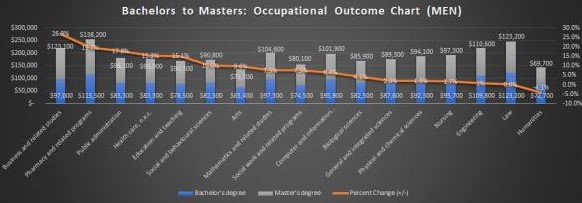
Table 4
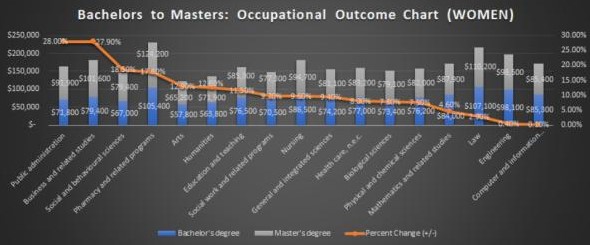
On the other hand, as detailed in table 4, women experience a 27.9% increase in median annual salary when completing a Master’s Degree in Business Administration (MBA) or other related studies, second only to Public Administration. As illustrated in both table 3 & 4, there’s a seemingly high market demand for MBA graduates, regardless of gender, due to the prevalence of a steep salary increase when students graduate. Manchester (2010) further supports the idea of high demand for MBA graduates by finding a positive correlation between higher turnover intention and employees who sign learning contracts for 12 months or less of service. The only strong evidence of employee loyalty after graduation are from MBA students who sign learning contracts that exceed 12 months of service (Manchester, 2010).
On the other hand, as detailed in Table 4, women experience a 27.9% increase in median annual salary when completing a Master’s Degree in Business Administration (MBA) or other related studies, second only to Public Administration. As illustrated in both tables 3 & 4, there’s a seemingly high market demand for MBA graduates, regardless of gender, due to the prevalence of a steep salary increase when students graduate. Manchester (2010) further supports the idea of high demand for MBA graduates by finding a positive correlation between higher turnover intention and employees who sign learning contracts for 12 months or less of service. The only strong evidence of employee loyalty after graduation is from MBA students who sign learning contracts that exceed 12 months of service (Manchester, 2010).
Another interesting finding was how high the payoff was for both men and women who pursue a master’s degree in public policy. According to the Stats Canada data (2018), women typically see an increase of 28% when upgrading to a master’s degree while men usually experience a 17.8% increase, good for third amongst other subjects. Looking further into the subject, Gow and Sutherland (2004) note that Master’s of Public Administration (MPA) programs generally equip students with the professional skills to work within various roles in government. This career path is typically similar to other professional degree programs such as medicine or law.
The consensus shows that support for educational funding and other professional development programs generally leads to lower turnover rates and higher value employees. In the next chapter, we’ll examine an organization that’s integrated learning and growth within its core values, thus becoming a global industry leader in the process.
Chapter 14: A case study of Microsoft - The ultimate learning organization
As we’ve continuously emphasized throughout this book, organizations that have been able to optimize their human capital and thrive in dynamic circumstances will succeed in the long haul. To conclude, as leaders in this age of artificial intelligence, embodying Transformational-Servant Leadership will help us take that next step in paving a better future for the generation after us. Desiring to leave a transformational impact, and serve others, will set practitioners on a course towards maximizing their God-given abilities for the greater good. Embedding Transformational-Servant Leadership within our cultural values will necessitate the establishment of learning organizations and maximizing our collective human capital. At the end of the day - Transformational-Servant Leadership, human capital, learning, adapting, growth - these are all just approaches that go hand-in-hand to cultivate human progression.
For aspiring Transformational-Servant Leaders, it’s ok to feel overwhelmed by this seemingly gargantuan task, we’re all humans in the end. Yet it’s a task that we need to complete. What helps sometimes is to break things down into manageable pieces and look towards organizations or people who’ve already paved the way. Microsoft is one such organization that, for several reasons, exemplifies the characteristics of a TSL-based organization, notably expressing the competencies of vision, adaptability, and innovation. Microsoft represents a familiar yet genuine example of an organization that has leveraged learning and human capital to propel themselves to titanic heights, such as becoming one of a few handful companies to reach a trillion-dollar valuation (Levy, 2019). In this chapter, we’ll explore how Microsoft uses what they dub as their “Culture of Learning,” to repeatedly propel themselves above their competitors for the past 50 years (Cortois, 2019). By understanding how a company like Microsoft translates a learning culture into practical outcomes, leaders from other domains can hopefully see the benefits outside of the theory and concepts provided in this book.
Reflecting on my journey towards writing this book, a curious story of how a string of unplanned events leads me to a full circle on discussing Microsoft in my last section. See, when I was researching solutions for addressing how automation will affect our society, I decided to attend a panel titled “The future of work: The impact of automation and digital transformation,” for some inspiration. One of the panel members who stood out to me was Eric Bridgewater, a Principal Software Engineering Manager at Microsoft, for reasons aside his title or the company he represented. Other panel members from local companies contributed valuable insights into how they were transforming their businesses alongside the rapid technological developments we’ve seen in the past decade. These panel members included Martha Carscadden from a local software company - Galvanize, Andrew McCurran from Metro Vancouver’s transportation authority - TransLink, and lastly, Shivam Kishore from Vancouver Economic Commission’s tech sector. However, during the discussions, there was a pivotal point I found hugely impactful from Bridgewater (2019) when he mentioned that at Microsoft, they seek people with strong values that contribute to their overall “culture of learning.” Microsoft’s culture of learning stood out to me because it was the first time I had seen an organization practice a systematic solution for adapting to change. This idea then led me towards an elaborate goose chase of understanding what exactly a “culture of learning” entails and how to apply it on a larger scale.
Skip ahead to a few months later, and I was then searching for organizations that exemplified Transformational-Servant Leadership characteristics to analyze for this final section. Microsoft was initially not on my short-list, as I was mistakenly focusing on organizations that provided comprehensive tuition reimbursement as a feature of learning cultures. In the time I was searching, I came across an article about Microsoft that illustrated an initiative of theirs that I found game-changing to society. Microsoft pledged to be carbon negative by 2030, becoming the first major corporation to make this commitment (Smith, 2020).
Climate change is an issue that I, along with countless others, are passionate about solving. Microsoft’s pledge to become carbon negative is stunning because they’ve become the first company to take a position on, in fact, resolving the issue of climate change through supporting initiatives that actively remove carbon from the atmosphere. The scientific community is in full agreement that if we, as global citizens, continue contributing to the planet’s increasing global mean surface temperature through our greenhouse gas emissions, it’s natural ecosystem will be permanently damaged (IPCC, 2018). Scientists have reported an approximate increase of 1℃ since pre-industrial times (around the 1800s) in the global mean surface temperature (GMST) from our greenhouse gas emissions (IPCC, 2018). The greater the GMST increases, the higher the prevalence of global catastrophes. One of the most talked-about consequences includes rising sea levels due to the melting polar ice caps, which will permanently damage the planet’s marine ecosystem and submerge areas of coastal cities like Vancouver, San Francisco, or Seattle (IPCC, 2018). Another significant consequence will be the changing weather patterns resulting from the global temperature increases. On its own, changing weather patterns will come with an abundance of repercussions, including an undoubted surge in the prevalence of forest fires and extreme weather storms, along with significant decreases in the planet’s food production (IPCC, 2018).
To address these concerns, the trend from modernized organizations these days is to pledge on carbon neutrality in order to market a sense of goodwill, most commonly phrased as corporate social responsibility (CSR), to consumers. While this pledge helps, it still does not get us any closer to permanently solving climate change. Smith (2020) clarifies that companies who are looking to exhibit CSR will pledge will use the phrase “net zero carbon emissions,” where they agree to pay a certain amount to remove as much carbon as they emit. These payments may come in the form of taxes to local governments, corporate funding for climate initiatives such as reforestation, or donating to environmental nonprofits, such as the Rainforest Alliance, who pledge to protect the Amazon Rainforest (Rainforest Alliance, n.d.). However, this is where the “net” comes into play regarding the terminology, rather than companies visibly pledging “zero carbon emissions,” as it hides the fact that they’re unwilling to reduce their corporate pollution altogether.
The other CSR buzzword that companies adopt is “carbon neutrality,” where they pledge to eliminate their greenhouse gas emissions (Smith, 2020). For organizations to promise not to add additional waste to our heavily polluted atmosphere is a significant contribution, since corporate emissions are one of the most significant contributors to climate change. However, this only slows down our trajectory towards exceeding the critical threshold of global irreversible damage, whereas Microsoft is working towards averting it (IPCC, 2018).
Microsoft’s initiative has since converted me to being a supporter of the brand while sparking an interest for them that I never had before. As I began researching the brand to satiate my curiosity, I further realized that they truly represented the ideal learning organization. I then remembered that it was someone from Microsoft that initially sparked my interest in learning organizations as an outcome of Transformational-Servant Leadership. Yes, it’s easy to point to Microsoft’s status as a trillion-dollar corporation that makes initiatives, such as learning and climate solutions possible. However, a better alternative is reverse-engineering their success to understand and implement the distinctive features that are relative to our organizations.
Problems at Microsoft.
To start with this in-depth dive into Microsoft’s learning culture, we should concisely look at its beginnings. Microsoft did not always have the culture and values we see today. Similar to many other large corporations, they, too, have experienced times of innovation mixed with conflict, candour as well as corruption.
Microsoft’s initiative to build a culture of learning started primarily when Satya Nadella succeeded Steve Balmer as the company’s CEO back on February 4, 2014 (Microsoft, 2019). During the time previous to Nadella’s succession to Balmer, Microsoft was experiencing what many would call the Dark Ages within the company’s history. There were rampant issues within Microsoft’s organizational practices during this time, with the preformance review systems topping most lists of widespread problems within the company (Stolzoff, 2019; Ibrarra, Ratten, & Johnston, 2018). In the company’s “stack-ranking preformance management system,” managers were often asked to rank each of their employees’ preformance from 1 to 5, and fulfill quotas for rating employers lower, despite their actual preformance relative to their teams (Ibarra, Ratten, & Johnston, 2018). This review meant that regardless of whether managers managed teams of high performers, there were always going to be employees who were rated poorly due to the management system’s poor design (Stolzoff, 2019).
Naturally, many of the organization’s cultural and systemic issues would originate from this stack-ranking review system. One of the most significant drawbacks of this review system was that it created a competitive yet toxic environment between employees at Microsoft. Employees were often frightful that their job security, compensation, preformance, or perceived value to company higher-ups would decrease as result of this review system (Stolzoff, 2019). Rather than working together collaboratively to achieve shared goals, information, talent, and ideas became a commodity amongst workers, which proceeded to rampant internal conflict and office politics (Ibarra, Ratten, & Johnston, 2018). Individual success within the organization was defined by how poorly others did and by how well they played the political game, rather than the quality of their work or their team’s overall success (Ibarra, Ratten, & Johnston, 2018). Ballmer’s leadership further purported these problems by opposing tech developer collaboration through open-source software, stating that the concepts conflicted against the organization’s long-standing values.
Externally, Microsoft also missed out on significant market capitalizations that shape today’s business conduct. During Ballmer’s era, the company focused mainly on selling software licenses and dominating the PC market over decisive industry players such as Apple. However, in the late 2000’ s/early 2010’s era, mobile technology began exploding, with Google and Apple competing for dominance in a space that we now know is integral to our daily lives. Microsoft attempted to follow suit by acquiring Nokia’s mobile device business for $7.2 billion and advance its mandate of becoming a “device and services company” (Gershgorn, 2019). As a result, Microsoft released its line of Windows phones to compete with iPhone and Android products and retake market share in this explosive space (Pierce, 2013). However, because Microsoft was late in realizing the potential of this market, their efforts to break into it largely failed, and the company lost millions over their forsaken attempt to capture significant market share.
Another significant opportunity that Microsoft missed was its business model in licensing software (Gershgorn, 2019). During this time, cloud technology began soaring, thus enabling companies to build large data centers that gave users simultaneous access, and thus increased connectivity and processing speed across all devices. The developments of cloud technology also enabled the adoption of the software-as-a-service business model, commonly known as SaaS, where companies charged customers with a smaller, yet re-occurring fee to access their cloud service infrastructure (Gershgorn, 2019). Over time, this business model proved to be more profitable as companies could continuously generate revenue like landlords owning apartment buildings. Realizing it’s potential, many Silicon Valley startups began adopting the SaaS model and competed directly with Microsoft’s software licensing (Gershgorn, 2019). Rather than charging small but consecutive fees, Microsoft’s software licensing business model, instead, charges customers a hefty, one-time fee for unlimited access to their operating system and its various features, such as Microsoft Word and Excel. This time, however, Ballmer and his leadership team recognized cloud computing’s underlying potential early enough. They began developing their offering, equating to the Microsoft Azure cloud, Office 365, and OneDrive products we see and use today.
Moreover, because Microsoft fell behind in critical aspects of the tech consumer market, board members were pushing Ballmer to carry out these plans sooner and reclaim the lost market share (Langley, 2013). At this point, it became apparent to Ballmer that it was time for a rejuvenation in Microsoft’s leadership (Langley, 2013). Then in August 2013, Ballmer effectively stepped down as Microsoft’s CEO to allow another, more capable candidate to lead the company back to its former glory as a top-tier industry player (Microsoft, 2013). Though Ballmer’s leadership inhibited the organization’s sustainability, he also initiated critical strategies that would set up its future CEO, Satya Nadella, for success, such as an early investment in cloud infrastructure.
Through all the cultural issues and failed business decisions of Microsoft, it came as a surprise to many that Satya Nadella was selected by the board to be its next CEO; despite his role in its struggles from his 21-year tenure with the company (Gershgorn, 2019). Among others in the company’s short-list were external candidates like Nokia’s CEO, Stephen Elop, and Ford Motors’ CEO, Alan Mulally (Langley, 2013). Part of Nadella’s success at inspiring the board’s confidence was that he knew Microsoft’s current culture wasn’t optimized for long-term success, despite its success relative to other industry players. As a result, Nadella spent his first years as CEO listening to employees and customers, learning the intricacies of his new role, and “renovating” the company’s culture; all qualities which, coincidentally, resemble that of a Transformational-Servant Leader (McLaren, 2019).
Vision.
As the company’s newly-appointed CEO, one of Nadella’s first acts was to re-emphasize its mission and core values “to empower every person and every organization on the planet to achieve more” (Microsoft, n.d.).
Somewhere along the way, this had been lost amongst the company’s struggles, both internally and externally. Nadella largely believed that this was due in part mostly to the company’s success, causing it to become out-of-touch with the realities in the industry and culture (Sherr & Guglielmo, 2018). The company’s success bred complacency, where instead of delivering true innovation and greater accessibility, their focus was on squeezing profit margins (Bariso, 2018). Nadella wanted to re-instill that sense of mission and purpose, ensuring that it captured the very essence of every employee’s work, the decisions they made, and the products that they create. Their focus had to return to empowering others through service to customers, providing them with real value that justifies the price they paid. He aimed to bring back aspects of the company’s early years when he worked with Microsoft’s initial co-founders, Bill Gates and Paul Allen to deliver breakthroughs in computer technology, and the company was purpose-driven on changing the world (Fortt, 2018). And while their purpose-driven approach communicates their effort to change the world as a company, it also extends to their work in the greater community by supporting and advancing humanitarian causes. For example, Microsoft has also deployed a subsection of it’s engineers to use their skills and collaborate with scientists on solving cancer (Linn, 2017). As it turns out, techniques in machine learning can be beneficial in identifying patterns in cancer cells that could lead to a better understanding of its progression and more rapid diagnosis (Linn, 2017). By empowering their employees to address issues that provide substantial change to humanity, Microsoft is providing them with real purpose in skills by partnering with the company to create real change in society, besides just tech.
Additionally, by spending time listening to his employees’ opinions, Nadella and his leadership team were able to pinpoint which aspects of the company’s culture needed changing, and simultaneously, involving them within the transformational process (McLaren, 2019). He aimed to transition the company’s values away from the competition that so many despised, to one of collaboration, respect, empathy, servitude, and learning. Nadella’s vision for the culture was no longer about market share or internally outperforming others, but of “empowering” customers and employees to maximize their potential.
Innovation
As Nadella often credits, one of the approaches that helped him achieve this corporate overhaul was by adopting an approach coined by Stanford psychologist Carol Dweck, known as the growth mindset (Bariso, 2018). Through the influence of Dweck’s book, Mindset, and collaboration with the Neuroleadership Institute, Nadella and his leadership team were able to transform Microsoft into the culture of learning that we see today (Weller & Derler, 2018).
With this approach, practitioners view learning as a dynamic and never-ending pursuit, where productive failure is encouraged, creativity is welcomed, and experimentation is the norm. Regardless of one’s innate talent, those with a growth mindset and inclination to learn will be more successful than those with a fixed mindset (Dweck, 2014). Additionally, people with a fixed mindset trap themselves in limitations by perceiving their growth as static. To them, everything in life becomes a zero-sum game with only winners and losers, smart and stupid people, good ideas and bad ones. Failure is an issue that’s especially difficult for people with fixed mindsets to deal with because it symbolizes a fixed outcome that defines their character, rather than for what it truly is, a stumble on a long journey. The small act of acknowledging our default tendency towards a fixed mindset and working to overcome it every day is the crux of what a growth mindset is, and one that’s pervasive within innovative, learning cultures (Dweck, 2014).
Another component of success in a cultural transformation is how much they’ve simplified these principles to employees. To do this, Microsoft’s leadership team utilized highly-researched principles from the fields of cognitive science to ensure that aspects of their desired cultural changes resonate with employees day in and day out (Weller & Derler, 2018). For example, the company updated it’s mission statement so that it resonates within our echoic memory, which is the tendency for our brain to recall sounds or phrases when we can repeat it to ourselves in three seconds or less (Rock, 2018).
In this Nadella’s newly-renovated culture of learning, employers were now encouraged to share ideas and collaborate, which allows for more innovation and collective growth. Values of inclusivity reached all-time highs because working at Microsoft meant feeling empowered to grow, where talent here was nurtured, not inherited, and that ultimately anyone could take part just by changing their mindset. To summarize, transforming from a company of “know-it-alls” to “learn-it-alls” (Weller & Derler, 2018).
To further cement the company’s commitment to collaboration, Microsoft acquired GitHub, an open-source development platform that enables developers from all over the world to develop, share, and review code (Sherr & Guglielmo, 2018). Alongside this, Microsoft also increased its connectivity to other brands by allowing its software to run on competing company’s operating systems, such as it’s Office 365 apps running on Apple’s IOS. While the outcome may not lead to domination over all things technology, Nadella’s vision for Microsoft’s product innovations is to be an integral piece to aspects of our daily lives. Whether users favour Google’s Cloud and Doc apps over its OneDrive and Word products as an example, they want to ensure that their Surface Pro devices deliver exceptional processing speeds and seamless integration.
Table 5. Microsoft stock price since it’s IPO

Since taking over in 2014, Nadella’s leadership has culminated in tangible benefits for the company, one of which being the quadrupling of its market value or its return to relevance in the industry. By instilling a growth mindset, employees began seeing their work and development as a personal journey towards something more, and hopefully one that crossed paths with the company’s mission. For this reason - learning, growth, passion, transformation - these ideals became cornerstones of the company’s innovation process of empowering others to achieve more. This was Satya Nadella’s vision when he succeeded Steve Balmer as CEO of Microsoft.
Adaptability.
In what’s, perhaps, their greatest contribution to society, Microsoft has improved society’s capacity to adapt to automation by opening avenues for learning. Microsoft is taking a direct approach towards equipping people for success in the Age of AI by providing the tools, skills, and products to facilitate learning and growth.
First looking at employees, Microsoft (n.d.) already offers generous benefits and development opportunities to all employees, not limited to tuition reimbursement, in-house training and development courses, access to influential public speakers, or on-campus libraries. While these benefits are standard for trillion-dollar companies, what’s more is that the organization’s learning initiatives don’t stop there.
The company has also fully embraced the power, scalability, and democracy of online education, allowing anyone with a functional internet connection to upgrade or learn new skills that are relevant to the labour market today. For example, with their Microsoft Learn platform, users are granted free access to their courses, certifications, and curated programs designed to teach proficiency in pertinent roles, such as a data analyst or AI engineer. Additionally, with their acquisition of LinkedIn in 2016, Microsoft (n.d.) has also expanded its online offerings through “LinkedIn Learning,” virtually a subscription-based platform that facilitates unlimited access to user-generated courses. Microsoft also supports students and educators of all ages through free access to essential apps and product discounts.
What’s more is that Microsoft will often outreach to students and educators of all interest to foster interest in the wonders of the tech industry, help educators modernize their current curriculum, or offer solutions to that increase student engagement. One of their initiatives is the “Microsoft Education Transformation Framework for Higher Education,” where teams will collaborate with schools and upgrade various aspects of their academic offerings (Microsoft, n.d.). Their transformation to modernizing their education delivery includes launching online classes, consulting educators on the uses of analytics tying to increase engagement, installing the required learning platform, upgrading research tools, and personalizing student’s academic pathways. Not only that, but these initiatives also come with minimal financial barriers by providing all students, educators, and institutions with free or discounted rates for their cloud services, software, or tech products.
The stories of Microsoft’s impact on students and learning outcomes are seemingly endless. However, to remove the air of naivety, these initiatives are also hugely beneficial to Microsoft’s bottom line. Repeated exposure to their products will breed brand affinity, which will likely lead to continued use. Nonetheless, their outreach provides mutual advantages for everyone. Microsoft gives learners the skills to adapt and succeed in an uncertain future while exposing them to their product ecosystem and instilling brand loyalty. Regardless, this entrepreneurship model of shared value is the key to solving various aspects of the world’s problems, from climate change to political conflict. By working together and ensuring fair participation in advancing humanity’s capabilities, everyone comes out a winner, thus realizing my vision for writing this book.
Chapter 15 - Conclusion: Strive for infinite progression within a finite lifetime.
To start, I want to sincerely thank everyone who’s been with me on my quest towards competing Trinity Western’s Master’s Degree in Leadership program. I especially want to acknowledge my girlfriend (soon to be fiance and future wife), Denise, for enduring the challenges that this program put us through and supporting me the whole way. I also want to thank my family and friends for their support, whether that was emotionally, intellectually, or sometimes financially. Whether you’re cognisant of it or not, you’ve all done so much in driving my graduate education to its completion. I want to acknowledge that my journey was a collective effort of people coming together to support the progression of one individual, whom I’m hoping will be able to reciprocate value in some way down the road. To my professors, classmates, and colleagues who’ve stimulated the necessary learning environment, I thank you and appreciate everything you’ve done. And lastly, I want to especially thank my Professors, Imbenzi George, Hyne-Ju Huizenga, and Angie Mays, who played integral roles in inspiring my ideas and nurturing my development throughout the last year-and-a-half. Without all your mentorship and encouragement, this project, my growth, couldn’t have come into fruition.
My goal for this book was to instill an affinity toward continuous learning and infinite growth. Transformational-Servant Leadership merely serves as the framework, tool, or approach to make this outcome a reality. TSL is a means of facilitating transformation amongst people towards an end of maximized human capital. Because the world is changing and competition is ramping up, leaders and their organizations can no longer be idle in their progression, if they hope to succeed in a future of AI. Similar to what we’ve seen with Microsoft, adopting a growth mindset will optimize our ability to learn, grow, and evolve. I hope this book was successful in communicating this message and spurring you to take action, starting with yourself, and then extending to your circles. This era is going to be an exciting one, unlike any other in human history. Will you take part in it?
- Happy Learning!
References
-
Anstoos, C. M. (2019). Maslow’s hierarchy of needs. In Salem Press Encyclopedia of Health. https://eds.a.ebscohost.com/eds/detail/detail?vid=5&sid=532e110b-7890-4466-800f-205dabe00261%40sdc-v-sessmgr02&bdata=JnNpdGU9ZWRzLWxpdmUmc2NvcGU9c2l0ZQ%3d%3d#AN=93872091&db=ers
-
Abel, J. R., & Deitz, R. (2012). Do colleges and universities increase their region’s human capital?. Journal of Economic Geography, 12(3), 667-691. https://academic.oup.com/joeg/article/12/3/667/984023
-
Arkes, J. (1999). What Do Educational Credentials Signal and Why Do Employers Value Credentials? Economics of Education Review, 18(1), 133–141. https://eds.a.ebscohost.com/eds/detail/detail?vid=1&sid=14706372-be70-400b-a3b9-1c3799d915df%40sessionmgr4006&bdata=JnNpdGU9ZWRzLWxpdmUmc2NvcGU9c2l0ZQ%3d%3d#AN=EJ579408&db=eric
-
Asrar-ul-Haq, M. & Anwar, S. (2018). The many faces of leadership: Proposing research agenda through a review of literature. Future Business Journal, 4(2), 179-188. https://doi.org/10.1016/j.fbj.2018.06.002
-
Autor, D. H., Levy, F., & Murnane, R. J. (2003). The skill content of recent technological change: An empirical exploration. The Quarterly Journal of Economics, 118(4), 1279-1333. https://economics.mit.edu/files/11574
-
Avolio, B. J., Gardner, W. L., Walumbwa, F. O., Luthans, F., & May, D. R. (2004). Unlocking the mask: A look at the process by which authentic leaders impact follower attitudes and behaviors. The Leadership Quarterly, (6), 801. https://ezproxy.student.twu.ca:3649/login.aspx?direct=true&db=edsgao&AN=edsgcl.195360598&site=eds-live
-
Ahmad, I. (2018, June 15). How much data is generated every minute? [Infographic]. SocialMediaToday. https://www.socialmediatoday.com/news/how-much-data-is-generated-every-minute-infographic-1/525692/
-
Alpaydin, E. (2016). Machine learning : The new AI. Cambridge, MA: The MIT Press. https://search.ebscohost.com/login.aspx?direct=true&db=nlebk&AN=1369420&site=eds-live
-
Barber, J. (2015, June 2). Canada’s indigenous school policy was ‘cultural genocide,’ says report. The Guardian. https://www.theguardian.com/world/2015/jun/02/canada-indigenous-schools-cultural-genocide-report
-
Bariso, J. (2018, November 26). This is the book that inspired Microsoft’s turnaround, according to CEO Satya Nadella: By encouraging a mindset of growth, Satya Nadella has made Microsoft cool again. Inc. https://www.inc.com/justin-bariso/this-is-book-that-inspired-microsofts-turnaround-according-to-ceo-satya-nadella.html
-
Bass, B. M. (1985). Leadership: Good, better, best. Organizational Dynamics, 13(3), 26–40. https://ezproxy.student.twu.ca:2420/10.1016/0090-2616(85)90028-2
-
Baywater, E., McCurran, A., Carscadden, M., & Kishore, S. (2019, August 22). The future of work: The impact of automation and digital transformation [Panel Discussion]. Brainstation, Vancouver, B.C., Canada. https://brainstation.io/event/future-of-work-yvr-2019?utm_source=meetUpYVR&utm_medium=PR&utm_campaign=YVRPanel_August2019
-
Benson, G. S., Finegold, D., & Mohrman, S. A. (2004). You Paid for the Skills, Now Keep Them: Tuition Reimbursement and Voluntary Turnover. Academy of Management Journal, 47(3), 315–331. https://doi.org/10.5465/20159584
-
Bet-David, P. [Valuetainment]. (2019, August 23). Kobe Bryant’s Last Great Interview [Video File]. https://youtu.be/T9GvDekiJ9c
-
Castellon, A., Peregrym, D. & Wollf, R. (2017). Values based leadership. Unpublished manuscript, Master of Arts in Leadership, Trinity Western University, Langley, Canada.
-
Cappelli, P. (2004). Why do employers pay for college? Journal of Econometrics, 121(1), 213-241. https://www-sciencedirect-com.ezproxy.library.ubc.ca/science/article/pii/S0304407603002641?via%3Dihub
-
Chevalier, A., Harmon, C., Walker, I. & Zhu, Y. (2004). Does education raise productivity, or just reflect it? The Economic Journal, 114, 499-517. https://eds-a-ebscohost-com.ezproxy.student.twu.ca/eds/detail/detail?vid=3&sid=6b315112-44e1-48ad-8994-534ffc75e334%40sdc-v-sessmgr02&bdata=JnNpdGU9ZWRzLWxpdmUmc2NvcGU9c2l0ZQ%3d%3d#db=edsjsr&AN=edsjsr.3590169
-
Chui, M., Manyika, J., & Miremadi, M. (2016). Four fundamentals of workplace automation. McKinsey Quarterly, 29(1), 1-9. https://ezproxy.student.twu.ca:2488/eds/detail/detail?vid=3&sid=c9a0787a-e42d-4309-a0fb-4049f8f9504a%40sessionmgr102&bdata=JnNpdGU9ZWRzLWxpdmU%3d#AN=edsgcl.462743462&db=edsgao
-
Chui, M., Manyika, J., & Miremadi, M. (2016). Where machines could replace humans—and where they can’t (yet). McKinsey Quarterly, 30(2), 1-9. McKinsey Digital. https://www.mckinsey.com/business-functions/digital-mckinsey/our-insights/where-machines-could-replace-humans-and-where-they-cant-yet
-
Cilluffo, F. & Cardash, S.L. (2019, January 29). What’s wrong with Huawei, and why are countries banning the Chinese telecommunications firm? The Conversation. theconversation.com/whats-wrong-with-huawei-and-why-are-countries-banning-the-chinese-telecommunications-firm-109036
-
CNBC. (2019, September 27). Why don’t we have self-driving cars yet? [Video file]. https://youtu.be/qf6VrDZ04EQ
-
Dictionary. (n.d.). Counter. In Dictionary.com. Retrieved January 1, 2020 from https://www.dictionary.com/browse/counter?s=t
-
Dai, Y., Dai, Y., Chen, K., & Wu, H. (2013). Transformational vs transactional leadership: Which is better?: A study on employees of international tourist hotels in taipei city. International Journal of Contemporary Hospitality Management, 25(5), 760-778. https://www.emerald.com/insight/content/doi/10.1108/IJCHM-Dec-2011-0223/full/html?src=recsys
-
D’Arcy, P. (2018, May 2). The best jobs in Canada: 2018. Indeed. http://blog.indeed.ca/2018/05/02/best-jobs-in-canada-2018/
-
Dweck, C. [Stanford Alumni]. (2014, October 9). Developing a growth mindset with Carol Dweck [Video]. YouTube. https://youtu.be/hiiEeMN7vbQ
-
Employment and Social Development Canada. (2019). Trend analysis: Explore the market. Government of Canada: Job Bank. https://www.jobbank.gc.ca/trend-analysis
-
Flair, I. (2019). Human capital. Salem Press Encyclopedia. https://eds.b.ebscohost.com/eds/detail/detail?vid=1&sid=25d2c473-59df-4fb0-a951-d2dced256590%40pdc-v-sessmgr06&bdata=JnNpdGU9ZWRzLWxpdmUmc2NvcGU9c2l0ZQ%3d%3d#AN=89677569&db=ers
-
Fortt, J. [CNBC]. (2018, January 17). *Microsoft CEO Satya Nadella talks successful business culture and cutting edge innovation CNBC* [Video]. https://www.youtube.com/watch?v=rM5KKxLlyvo -
Frey, C. B., & Osborne, M. A. (2017). The future of employment: How susceptible are jobs to computerisation?. Technological forecasting and social change, 114, 254-280. University of Oxford. https://www.oxfordmartin.ox.ac.uk/downloads/academic/The_Future_of_Employment.pdf
-
Frick, D.M. (n.d.). Robert K. Greenleaf biography. Robert K. Greenleaf Center for Servant Leadership. https://www.greenleaf.org/about-us/robert-k-greenleaf-biography/
-
Garvin, D. A. (1993). Building a learning organization. Harvard Business Review, 71(4), 78–91. https://search.ebscohost.com/login.aspx?direct=true&db=bth&AN=9309166478&site=eds-live&scope=site
-
Gow, J. I., & Sutherland, S. L. (2004). Comparison of Canadian master’s programs in public administration, public management and public policy. Canadian Public Administration, 3, 379. http://www.cappa.ca/images/accreditation/backgroundreports/gow-sutherland.pdf
-
Graetz, G. & Michaels, G. (2018). Robots at Work. The Review of Economics and Statistics, 100(5), 753-768. https://doi.org/10.1162/rest_a_00754
-
Greenleaf, R. K. (1991). The servant as leader. Robert K. Greenleaf Center. https://search.ebscohost.com/login.aspx?direct=true&db=cat05965a&AN=alc.156280&site=eds-live
-
Gregershorn, D. (2019, February 18). A complete guide to Microsoft’s comeback. Quartz. https://qz.com/1552298/a-complete-guide-to-microsofts-comeback/
-
Huawei Technologies Co. (n.d.). Our vision, mission, and strategy. Huawei. https://www.huawei.com/en/about-huawei/
-
Hughes R. & Colarelli-Beatty K. (2005) Becoming a strategic leader: Your role in your organization’s enduring success. Jossey-Bass.
-
Ibarra, H., Rattan, A., & Johnston, A. (2018). Microsoft: instilling a growth mindset. London Business School Review, 29(3), 50–53. https://eds-b-ebscohost-com.ezproxy.student.twu.ca/eds/pdfviewer/pdfviewer?vid=3&sid=ecab9ad2-c98d-49bc-b9dd-ebde021fd386%40sdc-v-sessmgr03
-
Imbenzi, G., Williaume, D. & Page, D. (2013).Transformational servant leadership. Unpublished manuscript, Master of Arts in Leadership. Trinity Western University: Langley, Canada.
-
Intergovernmental Panel on Climate Change (IPCC). (2018). Summary for policymakers: Global warming of 1.5℃. https://www.ipcc.ch/sr15/chapter/spm/
-
Johnson, C. E. (2018). Meeting the ethical challenges of leadership: Casting light or shadow. Sage. https://play.google.com/books/
-
Keith, K.M. (2017, June 6). He was a servant first, a servant at heart. Greenleaf. https://www.greenleaf.org/servant-first-servant-heart/
-
Kilpatrick, S. T. (2019). Natural selection. Salem Press Encyclopedia of Health. https://search.ebscohost.com/login.aspx?direct=true&db=ers&AN=94416605&site=eds-live&scope=site
-
Krueger, A. (2017). “Where Have All the Workers Gone? An Inquiry into the Decline of the U.S. Labor Force Participation Rate.” Brookings Papers on Economic Activity, 1. https://ezproxy.student.twu.ca:3649/login.aspx?direct=true&db=edsjsr&AN=edsjsr.90019454&site=eds-live
-
Lalande, D., & Baumeister, R. F. (2019). Systems theories (psychology). Salem Press Encyclopedia of Health. https://search.ebscohost.com/login.aspx?direct=true&db=ers&AN=93872299&site=eds-live&scope=site
-
Laird, P. (2015). Vision, mission, values & essence. Unpublished manuscript, Master of Arts in Leadership. Trinity Western University: Langley, Canada.
-
Lamb, C. (2016). The talented Mr. Robot: The impact of automation in Canada’s workforce. Research from Brookfield Institute website: http://brookfieldinstitute.ca/report/the-talented-mr-robot/
-
Lamb, C. & Lo, M. (2017). Automation across the nation: Understanding the potential impacts of technological trends across Canada. Research from Brookfield Institute website: https://brookfieldinstitute.ca/report/automation-across-the-nation/
-
Langley, M. (2013, November 17). Ballmer on Ballmer: His exit from Microsoft. The Wall Street Journal. https://www.wsj.com/articles/ballmer-on-ballmer-his-exit-from-microsoft-1384547387?tesla=y#printMode
-
Lateef, Z. (2019, June 19). 5 Data Science Projects - Data Science Projects For Practice. Edureka! https://www.edureka.co/blog/data-science-projects/
-
Leadership integration project manual 2017-2018. (2016). Unpublished manuscript, Master of Arts in Business Leadership - Richmond, Trinity Western University, Canada.
-
Leopold, T.A., Ratcheva, V., & Zahidi, S. (2018). The future of jobs report 2018. World Economic Forum. http://www3.weforum.org/docs/WEF_Future_of_Jobs_2018.pdf
-
Levy, A. (2019, April 25). Microsoft hits $1 trillion market cap for the first time as stock jumps on an earning beat. CNBC. https://www.cnbc.com/2019/04/25/microsoft-hits-1-trillion-market-cap-for-the-first-time-on-earnings.html
-
Linn, A. (2017). How Microsoft computer scientists and researchers are working to ‘solve’ cancer. Microsoft Story Labs. https://news.microsoft.com/stories/computingcancer/
-
Manchester, C.F. (2010). Investment in general human capital and turnover intention. The American Economic Review, 100(2), 209. https://eds-b-ebscohost-com.ezproxy.student.twu.ca/eds/pdfviewer/pdfviewer?vid=3&sid=a755e573-8b5d-4275-bc13-58723bd6bd39%40pdc-v-sessmgr04
-
Manchester, C. F. (2012). General human capital and employee mobility: How tuition reimbursement increases retention through sorting and participation. ILR Review, 65(4), 951–974. https://doi.org/10.1177/001979391206500408
-
Marciano, P.L. (2010). Carrots and sticks don’t work: Build a culture of employee engagement with the principles of RESPECT. McGraw Hill. https://play.google.com/books/
-
McKinsey Global Institute. (2017). The future of work in America. www.mckinsey.com/mgi
-
McLaren, S. (2019, December 4). How Microsoft “renovated” its culture by following these 3 steps. LinkedIn. https://business.linkedin.com/talent-solutions/blog/company-culture/2019/3-steps-microsoft-took-to-renovate-culture
-
McLeod, S. (2018). Maslow’s Hierarchy of Needs [Digital image]. Retrieved October 7, 2018, from https://www.simplypsychology.org/maslow.html
-
Microsoft. (2013, August 23). Microsoft CEO Steve Ballmer to retire within 12 months. https://news.microsoft.com/2013/08/23/microsoft-ceo-steve-ballmer-to-retire-within-12-months/
-
Microsoft. (2020, December 31). Facts About Microsoft. https://news.microsoft.com/facts-about-microsoft/
-
Microsoft. (n.d.). Our corporate values. https://www.microsoft.com/en-us/about/corporate-values
-
Miller, J. (2019). In The Canadian Encyclopedia., Residential Schools in Canada. https://www.thecanadianencyclopedia.ca/en/article/residential-schools
-
Mitchell, K., Strong, H., Williaume, D. & Wu, T. (2017). Leadership competency framework. Unpublished manuscript. Master of Arts in Leadership. Trinity Western University: Langley, Canada.
-
Mohn, E. (2018). Internet of Things. Salem Press Encyclopedia of Science. https://search.ebscohost.com/login.aspx?direct=true&db=ers&AN=100558386&site=eds-live
-
Northouse, P. G. (2016). Leadership: Theory and practice (7th ed.). Sage Publications.
-
Pattie, M., Benson, G. S., & Baruch, Y. (2006). Tuition reimbursement, perceived organizational support, and turnover intention among graduate business school students. Human Resource Development Quarterly, 17(4), 423–442. https://eds.b.ebscohost.com/eds/detail/detail?vid=1&sid=31d48115-0ae1-411d-9254-0578467a0cfc%40pdc-v-sessmgr04&bdata=JnNpdGU9ZWRzLWxpdmUmc2NvcGU9c2l0ZQ%3d%3d#db=eric&AN=EJ759113
-
Pierce, D. (2013, September 2). Microsoft buying Nokia’s phone business in a $7.2 billion bid for it’s mobile future. The Verge. https://www.theverge.com/2013/9/2/4688530/microsoft-buys-nokias-devices-and-services-unit-unites-windows-phone
-
Rainforest Alliance. (2020). Forests. Rainforest Alliance. https://www.rainforest-alliance.org/issues/forests
-
Rhoades, L., & Eisenberger, R. (2002). Perceived organizational support: A review of the literature. Journal of Applied Psychology, 87, 698–714. https://eds-b-ebscohost-com.ezproxy.student.twu.ca/eds/pdfviewer/pdfviewer?vid=4&sid=56b241d0-0d70-481f-b011-d335c6bf2fe0%40pdc-v-sessmgr01
-
Rock, D. (2018). Tell employees what you want them to strive for (in as few words as possible). Harvard Business Review, 2. https://hbr.org/2018/02/tell-employees-what-you-want-them-to-strive-for-in-as-few-words-as-possible
-
Skemp, K. M. (2019). Cloud computing. Salem Press Encyclopedia of Science. https://eds.a.ebscohost.com/eds/detail/detail?vid=1&sid=1eb63897-4af9-4be8-ba8d-224a834150bc%40sdc-v-sessmgr01&bdata=JnNpdGU9ZWRzLWxpdmUmc2NvcGU9c2l0ZQ%3d%3d#AN=87323246&db=ers
-
Stackhouse, J., Borra, J., Klimbovskaia, Aulthouse, A. (2018). Humans wanted: How Canadian youth can thrive in the age of disruption. Royal Bank of Canada. https://www.rbc.com/dms/enterprise/futurelaunch/humans-wanted-how-canadian-youth-can-thrive-in-the-age-of-disruption.html
-
Statistics Canada. (2018). Portrait of Canada’s labour force. https://www12.statcan.gc.ca/nhs-enm/2011/as-sa/99-012-x/99-012-x2011002-eng.cfm
-
Schwab, K. (2016, January 14). The Fourth Industrial Revolution: What it means, how to respond. World Economic Forum. https://www.weforum.org/agenda/2016/01/the-fourth-industrial-revolution-what-it-means-and-how-to-respond/
-
Senge, P. M. (2006). The fifth discipline: The art and practice of the learning organization. Currency Doubleday.
-
Sherr, I. & Guglielmo, C. (2018, August 30). This is not your father’s Microsoft. CNET. https://www.cnet.com/news/this-is-not-your-fathers-microsoft/
-
Simpson, S.D. (2019, June 25). 5 Of The Most Adaptive Companies. Investopedia. https://www.investopedia.com/financial-edge/0311/5-of-the-most-adaptive-companies.aspx
-
Spears, L. C., & Lawrence, M. (Eds.). (2002). Focus on leadership: Servant-leadership for the twenty-first century. John Wiley & Sons.
-
Silver, D., Hubert, S., Schrittwieser, J., & Hassabis, D. (2018, December 6). AlphaZero: Shedding new light on chess, shogi, and Go. Deepmind. https://deepmind.com/blog/article/alphazero-shedding-new-light-grand-games-chess-shogi-and-go
-
Smith, B. (2020, January 16). Microsoft will be carbon negative by 2030. Microsoft. https://blogs.microsoft.com/blog/2020/01/16/microsoft-will-be-carbon-negative-by-2030/
-
Stolzoff, S. (2019, February 1). How do you turn around the culture of a 130,000-person company? Ask Satya Nadella. Quartz. https://qz.com/work/1539071/how-microsoft-ceo-satya-nadella-rebuilt-the-company-culture/
-
Stone, A.G., Russell, R. F., & Patterson, K. (2004). Transformational versus servant leadership: A difference in leader focus. Leadership & Organization Development Journal, 25(4), 349-361. Emerald Insight. www.emeraldinsight.com/0143-7739.htm
-
Sung, S. Y., & Choi, J. N. (2014). Do organizations spend wisely on employees? Effects of training and development investments on learning and innovation in organizations. Journal of Organizational Behavior, 35(3), 393–412. https://doi.org/10.1002/job.1897
-
Tesla. (2017, November 16). Tesla Semi. https://www.tesla.com/en_CA/semi
-
Trevor, C.O. (2001). Interactions among actual ease-of-movement determinants and job satisfaction in the prediction of voluntary turnover. The Academy of Management Journal, 44(4), 621. https://eds.a.ebscohost.com/eds/detail/detail?vid=3&sid=68aadf2d-8f39-416e-b958-1b2609060b18%40sdc-v-sessmgr03&bdata=JnNpdGU9ZWRzLWxpdmUmc2NvcGU9c2l0ZQ%3d%3d#AN=edsjsr.3069407&db=edsjsr
-
University of Waterloo. (n.d.). About Data Science. https://uwaterloo.ca/data-science/about
-
Wall, K., Zhao, J., Ferguson, S., & Rodriguez, Z. (2018). Results from the 2016 census: Is field of study a factor in the payoff of a graduate degree? Statistics Canada. https://www150.statcan.gc.ca/n1/pub/75-006-x/2018001/article/54978-eng.htm
-
Watson, L. E. (1988). Light from many lamps. Simon & Schuster.
-
Weller, C. & Derler, A. (2018, November 22). How Microsoft overhauled its approach to growth mindset. NeuroLeadership Institute. https://neuroleadership.com/your-brain-at-work/microsoft-growth-mindset-transformation
- Yang, A. (2018). The war on normal people: The truth about America’s disappearing jobs and why universal basic income is our future. Hachette Books.